 Photo by Julianna Leopold
 Atlanta
Our Lady of the Assumption expands campus with outdoor STEM space
By NATALIA DURON, Staff Writer | Published February 19, 2026 | En Español
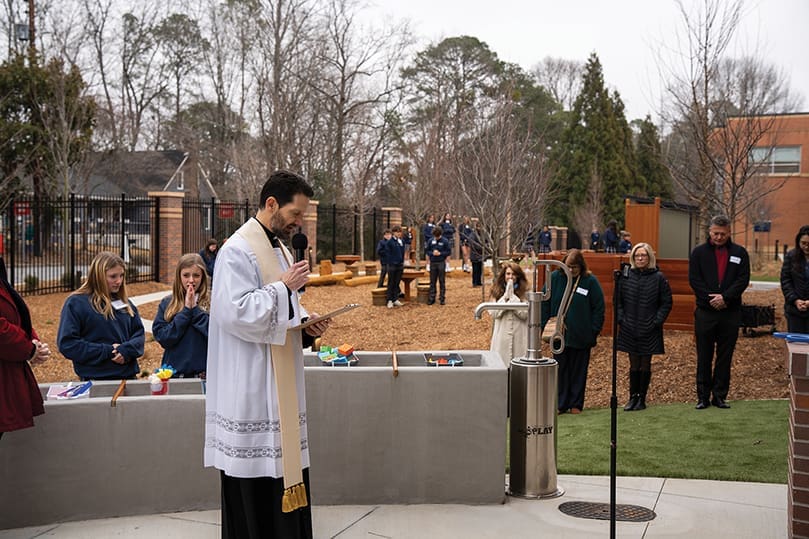
ATLANTA—Our Lady of the Assumption School celebrated the opening of its new outdoor STEM learning space with a ceremony on Feb. 5.
The event marked the completion of a major campus expansion designed to bring science, technology, engineering and mathematics classrooms outdoors.
Father Daniel Ketter, pastor of Our Lady of the Assumption Church, opened the ceremony with prayer among faculty, students and supporters.
Principal Mandy Crock shared the space was designed with young learners at the center.
“To the students, this is for you,” Crock said. “We cannot wait to see all the learning and play that will occur here.”
The STEM lab was the vision of Lisa Cordell, director of Open Doors Program and former principal of OLA. Nearly eight years ago, Cordell began imagining a learning environment where students could explore STEM concepts through experience and discovery.
She said that her vision was a space where “science and math could come alive and inspire independent curiosity.”
Bishop John N. Tran blessed the area and thanked those who helped make the project possible.
“Because of your generosity, our students are being prepared for the future,” said the bishop. “They will form in critical thinking, problem solving, collaboration, creativity and strong work ethics … their curiosity and wonder in God’s creation will awaken as they study.”
School leaders and clergy cut a ceremonial ribbon together, officially opening the space to applause and cheers.
The new spot transformed a previously underutilized area at the north end of campus into a multi-use environment. The space includes an outdoor classroom with amphitheater-style seating with multiple hands-on learning stations. These include a physics and hydrodynamics lab featuring a gravity track where students test wheeled and water-powered vehicles, a structured engineering zone where students can build a home using “Lincoln logs” and a play kitchen with running water.
Additional areas include a kinetic balance area, a whiteboard challenge wall for students to draw or solve math problems and a tabletop for games and small group collaboration.
The entire area was also designed to be widely accessible, allowing students with physical disabilities to participate.
Students staffed the stations during the ceremony, explaining to visitors how each area works and what they were learning. Eighth grader Reece Albert demonstrated the gravity track, showing how water flow affects vehicle movement.
“This space is really awesome,” Albert said. “I love that everything here is a hands-on activity, because it makes learning so much fun.”
The project represents the latest milestone in a partnership between the school and the David R. Clare and Margaret C. Clare Foundation. The collaboration began in 2018 and was supported by the late Dr. Chris Clare, a longtime advocate for Catholic education and promoter for the school’s STEM programs.
In 2024, the foundation awarded the school a $2 million grant, the largest contribution in the school’s history, to support the construction of the learning space and its long-term sustainability.
“The dedication of everyone involved has been nothing short of fantastic,” Cordell said at the dedication. “I am confident this space will serve as a place for students to learn and experiment for generations to come.”