


 PHOTO BY NATALIA DURON
Atlanta
‘The antidote to violence is love’: Mass remembers victims of state violence
By NATALIA DURON | Published November 25, 2026
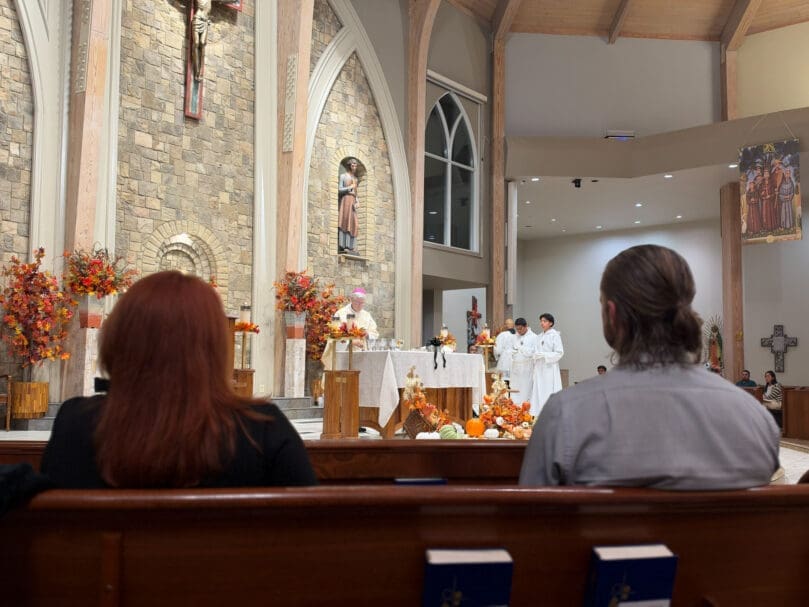
ATLANTA—On Nov. 2, Catholics in Atlanta gathered at Holy Cross Church for a Mass of Remembrance for Victims of State Violence. The Mass remembered the lives of 77 people executed by Georgia since the reinstatement of the death penalty in 1976.
Celebrated on All Souls’ Day by Bishop Bernard E. Shlesinger III, auxiliary bishop of the Archdiocese of Atlanta, the liturgy offered prayers for those who had been executed and reflected on the Catholic teachings of opposition to capital punishment.
In his homily, Bishop Shlesinger acknowledged the profound grief experienced by families who have lost loved ones to murder. He also reflected on his visits with men on death row, where he had witnessed repentance and hope.
“There’s misery on death row,” he said. “There’s misery in the hearts of people whose loved ones have been killed,” he said. “But we can never lose sight, brothers and sisters, of the dignity of the human person.”
Bishop Shlesinger emphasized that the pursuit of justice must not come at the expense of mercy. While recognizing the responsibility to teach right from wrong, respect the law and heal the wounds of victims, he cautioned against allowing anger and bitterness to lead to vengeance.
“Capital punishment is cruel and unnecessary today to preserve the life of others as a form of legitimate defense of life,” he said, adding that executions can be arbitrary and carry racial undertones.
“Our witness to respect life shines most brightly when we demand respect for each and every human life, including the lives of those who fail to show that respect for others,” he said.
Bishop Shlesinger pointed to Jesus’ words from the cross, “Father, forgive them, they know not what they do,” as an example of a love that does not seek retaliation.
“The antidote to violence is love,” he said.
Drew Denton, director of Restorative Justice Ministries for the archdiocese’s Office of Life, Dignity and Justice, said the Mass was particularly meaningful because of its timing on a feast day when Catholics pray for the souls of the departed.
“When the state condemns someone to death, it singles that person out, in a public and definitive way, as being beyond redemption,” Denton said. “As Catholics, we believe that nobody is beyond hope of redemption.”
The Mass offered a public opportunity to pray for people whom the criminal justice system has condemned, he said, and served as a witness to the Gospel message of reconciliation.
Denton also highlighted a central point of the bishop’s homily, that defending the dignity of people on death row does not diminish the dignity of victims of violent crime or disregard public safety.
“As the catechism teaches, we can do all these things in a way that does not ‘definitively deprive the guilty of the possibility of redemption’,” he said. “And in doing so, we also free ourselves from the very real danger of building a ‘prison’ within our own hearts.”
The Church teaches that punishment must respect the dignity of the human person and preserve the possibility of redemption. In 2018, Pope Francis approved a revision to the Catechism of the Catholic Church that declared the death penalty inadmissible and called for its abolition.
Jayna Hoffacker, executive director of the Georgia Catholic Conference, said the gathering was an opportunity to reflect on the connection between Christ’s suffering and those who have been executed.
“It is not often thought of in these terms, but Jesus himself was a victim of state violence,” Hoffacker said. “The Crucifixion was an execution. And whether an individual is innocent or guilty, we should always recall that they are dying the same death as Christ.”
Hoffacker said the teaching on human dignity extends beyond the protection of life itself to include each person’s ability to develop and thrive.
“We are all called, in light of our baptism, to live and work in solidarity with our brothers and sisters for the liberation and dignity of all,” she said.
The 77 people remembered were executed in Georgia between 1983 and 2024. The first, John Eldon Smith, was executed Dec. 15, 1983, after the U.S. Supreme Court reinstated the death penalty in 1976. The most recent was Willie James Pye, who was executed March 20, 2024.
Among those executed was Kelly Renee Gissendaner, the only woman on the list. Her execution in 2015 drew attention from Catholics and others who advocated for clemency. The case of Troy Anthony Davis, executed in 2011, also received international attention amid questions about his conviction and claims of innocence.
For Catholics seeking to support people affected by the death penalty, Denton encouraged continued prayer for those on death row, for the release of innocent people and for the repentance and reconciliation of those who have committed crimes.
He also pointed to the archdiocese’s annual collection of Christmas packages for prisoners on death row. The packages include basic items such as towels, toiletries and snacks to remind incarcerated individuals that they have not been forgotten.
Hoffacker encouraged parishioners to support New Hope House, which provides hospitality to families and friends visiting loved ones on death row, including during executions. She also encouraged Catholics to get involved with Georgia Catholics Against the Death Penalty, which advocates for the abolition of capital punishment.
Bishop Shlesinger reminded the congregation of the responsibility Catholics share to remain connected to one another, even in the face of injustice and death.
He urged the faithful to “make a commitment to life and to love, to say to those who perhaps the world does not love, that we will not forget you.”