


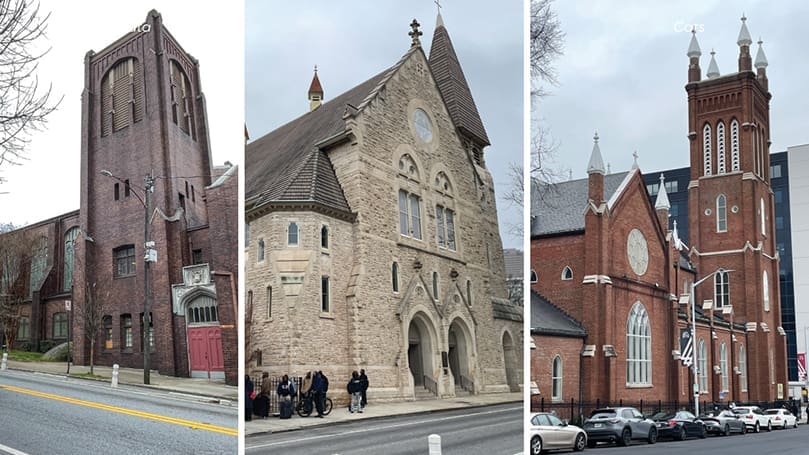
 Photo by Andrew Nelson
Atlanta
Atlanta’s Shrine part of a trio of churches expanding affordable housing
By ANDREW NELSON, Staff Writer | Published March 5, 2026 | En Español
ATLANTA—Real estate turns on hard metrics like location, cost and square footage. But among the three churches involved with the Capitol Hill Neighborhood Development Corporation, a vital force is prayer.
More than 30 years ago, two Protestant churches and one of the oldest Catholic churches in the Archdiocese of Atlanta formed this unusual coalition. Its goal is to shape the neighborhood around the golden dome of the State House—surrounded in large part by government buildings, parking lots and social services—to aid men and women who live on the streets.
The three churches were all founded in 19th century Atlanta. They are the Shrine of Immaculate Conception, Central Presbyterian Church and Trinity United Methodist Church. Each church shares a calling to serve the less fortunate and are places where faith is shown through action. Their joint real estate corporation leverages cajoling, advocacy and real estate expertise to direct the revitalization of the neighborhood and expand affordable housing.
“We’re here for something higher,” said Bill Adams, one of its founding members. “They’re all Christian churches and so (we are) trying to follow in the footsteps of Christ and trying to make the world better, trying to house folks.”
Now, the development corporation (CHNDC) is watching its largest project rise as a 10-story apartment building, years in the making. The property will be home for what’scalled workforce housing, targeting people working in nearby hotels, restaurants and government workers.
The nonprofit grew out of a shared vision to influence the city blocks around them. CHNDC is made up of three board members from each congregation plus the pastor from each of the three churches.
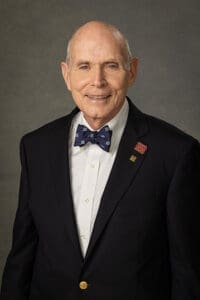
Shrine parishioner Bill Adams is a founder of the nonprofit development corporation.
Adams, 77, traces a branch of his family tree to the Shrine back to 1852. He was baptized there and has not left. He started his real estate career in 1972. Adams’ firm specializes in working with urban developers, local governments and small business owners.
“We don’t want stuff going down here that would deteriorate the neighborhood and make it worse,” he said.
At its meetings, real estate may be on the agenda, but the conversation is inevitably richer. The pastors connect and share what’s going on in their congregations, obstacles and wins, and they form friendships.
The group has successfully directed the development of land they do not own by “nudging” the city of Atlanta and developers, said Jerry Miller, another founding member.
Now there is an effort to recruit younger board members to ensure the organization remains intact.
The development corporation is just one way the trio of churches cooperates. For decades, the three have shared resources, especially during crises. Following a devastating fire at the Shrine in 1982, Central Presbyterian hosted Catholic Masses. And when Central underwent renovations, they utilized the Shrine’s facilities. Both host a men’s night shelter during the winter months. Currently, Trinity United Methodist Church is downsizing and will soon hold services and outreach efforts at the Shrine.
Miller, 75, spent a career as a developer converting older buildings into lofts that are integrated into neighborhoods. His family in the 1980s was drawn to the Central Presbyterian Church for its outreach efforts.
Prayer centers the organization’s purpose, not a typical practice seen among real estate deals.
“We’re not doing this for us. We’re doing this to create a ‘City on the Hill,’” said Miller. “We’re not a typical development organization. We’re not just building apartment complexes, but we’re responding to the needs of the city.”
One of its proud successes was fostering a 70-bed supportive housing project called Hope House built on land the CHNDC helped secure from Atlanta, he said.
It also designed the construction of a city parking deck, ensuring it was built capable of supporting future housing units.
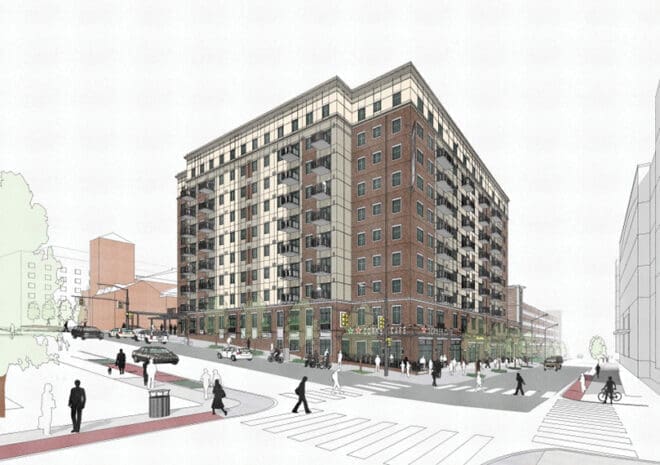
A development nonprofit of three churches teamed with Radiant Development Partners to propose a 218-unit affordable housing complex, Trinity Central Flats, at Trinity Avenue and Shirley C. Franklin Blvd. in Atlanta. Twenty units will be reserved for Partners for Home, which works with people needing permanent shelter. Photo Courtesy of Radiant Development Partners/CHNDC
Its most ambitious project is now underway, named Trinity Central Flats. The 218-apartment building will go up across from Atlanta City Hall. The church group is working with Radiant Development Partners on the affordable housing development. Construction is expected to take two years. A ceremonial groundbreaking is scheduled for March.
The plot of land for the new apartment was once eyed for a public safety headquarters, but more than a dozen years ago the organization convinced city leaders to reserve it for affordable housing. Then it had to push back against the idea to convert the lot into an urban farm. As part of the work, the corporation holds 25% interest in the general partnership and a 99-year lease from Invest Atlanta for the land.
Supporters said the apartment building is focused on giving affordable housing options to people who work nearby in the hospitality industry. All the units will be offered at below-market rates, with most reserved for people earning around half of the area’s median income. No resident will be required to pay more than 30 percent of their income. Among the planned amenities are a bicycle storage room, an arts and crafts room, a computer lab, and other communal spaces. In addition, the project will add street-level stores downtown.
Church members insisted that the design of the apartment building reflects their care for their neighbors who are homeless. The organization dedicated at least 20 units in the project to be reserved for Partners for Home, Miller said.
The nonprofit Partners for Home places homeless people into permanent supportive housing. This inclusion was a specific requirement pushed for by the CHNDC board to aid the people who are homeless in the surrounding neighborhood, Miller said.
With the different faith traditions sharing a common mission to look out for people on the margins, the corporation’s members joke the neighborhood could be named the Ecumenical Hill as a “force in the neighborhood,” said Adams.