 Photo by Julianna Leopold
Norcross
Archbishop’s Q&A session covers canonization process, saintly living
By GEORGIA BULLETIN STAFF | Published September 23, 2025 | En Español
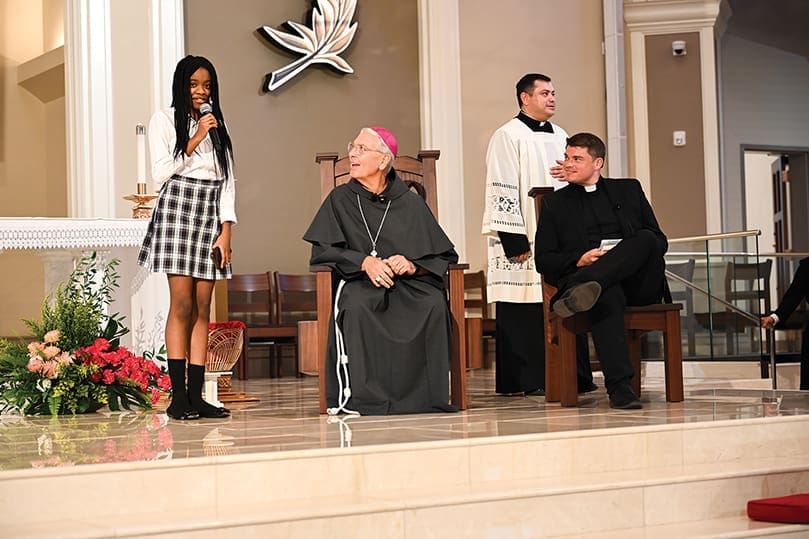
NORCROSS—Archbishop Gregory J. Hartmayer, OFM Conv., and Father Branson Hipp, of the Catholic Center at Georgia Tech, hosted a question-and-answer session following the Mass of Thanksgiving for St. Carlo Acutis and St. Pier Giorgio Frassati on Sept. 7.
Those posing questions were Jane Okonkwo, ninth grade St. Mary’s Academy Student; Melissa Romo, of the Archdiocese of Atlanta’s Hispanic young adult ministry; Jesus Rodriguez, of the Archdiocese of Atlanta’s office of Priest Personnel; Father Gerardo Ceballos Gonzalez, Archdiocese of Atlanta archbishop priest secretary; and an attending parishioner.
The following question and answers are derived from the session and were lightly edited for space:
JANE OKONKWO: What does it take to become a saint?
ARCHBISHOP GREGORY HARTMAYER: Well, not all saints have halos, and not all angels have wings. To have the official title saint, you have to be canonized by the church, by the Holy Father. And there’s various steps that are taken by the church to investigate the holiness of the person: the devotion that people have of this person, what was their life like, what was their relationship with Christ. And then there’s a miracle that must take place.
If they haven’t been martyred, that’s a miracle in itself. If you are not martyred, but just a holy person and demonstrated that in the way you lived your life, and people saw that and began to pray through their intercession for you, and a miracle happens because of it, then the church investigates it. Whether it’s medical or psychological or whatever it might be, the church takes a great deal of time and effort to make sure that it really is unexplainable any other way. If the first miracle is accepted by the church, the person would become beatified; blessed. Another miracle needs to take place in order for them to be canonized. So, there are two miracles, and both these saints had two miracles attributed to them.
Again, not all saints have halos. There’s a lot of saints that are up in heaven that we don’t even know about. Even some of our relatives. But the ones that we do know about are the ones that we know publicly. But there are many in heaven that we don’t know about, and that continues because of people like you who strive to become holy in your life, in your own vocation.
MELISSA ROMO: How can we encourage youth groups to devotion to the Eucharist the way St. Carlo Autis did?
ARCHBISHOP HARTMAYER: Well, they, both Pier and Carlo had a great devotion to the Eucharist. How could they not? How could a saint not have a devotion to the Eucharist when it is the center and the summit of our faith? That’s a miracle every time we come to Mass. Adoration outside of Mass is a wonderful way for Catholics to continue a devotion to the Eucharist, to have silent prayer, conversation and an encounter with Christ. The more we become like Christ and be with Christ, then the more grace we receive and the holier we become. So, you can’t go wrong by coming to Mass as often as you can to develop a real personal devotion to the great gift of the Eucharist.
JESUS RODRIGUEZ: With the canonization, how will that help us, the young new generations that are getting married? How will that impact us or how can we pray for (the new saints) as a family?
FATHER BRANSON HIPP: We have to have this recognition that none of us live this alone. We’re meant to live our vocations together. Pier Giorgio Frassati was a man of immense friendship. He also had so much support from his community. I think especially in the modern world we try to live things as if we are alone, even as an individual in a family unit. And the reality is we were never meant to live these things alone. We’re made for communion. I think the gift of the saints is this recognition that “I don’t live this alone, that I need others, that I am made for a community. That I am made to have a family unit and to help each other go to Mass and to pray together; to get creative in all of the wildness of modern life.” It’s this thing of helping each other through creativity, saying “yes” to the Lord and asking questions together.
ARCHBISHOP HARTMAYER: Family life is known as the domestic church. It’s the church at home. And that’s where vocations to the priesthood, to religious life, to the lay ministry, that that’s where those vocations come from is the domestic church, your home. Our parents are our first teachers and our best teachers in the ways of the faith. And so, the home life, especially those early years, you come to know Jesus personally and you’ll grow in love and relationship and friendship.
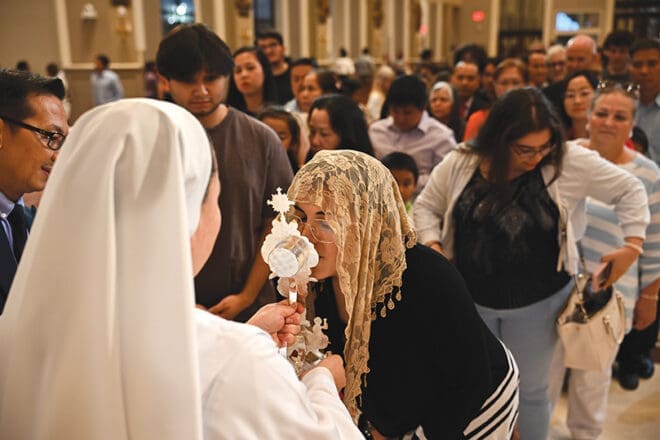
Sister Miriam Mendoza holds the relic of St. Carlo Acutis as the faithful make their way forward for veneration at Holy Vietnamese Martyrs Church. Photo by Julianna Leopold
FATHER GERARDO CEBALLOS GONZALEZ: Archbishop, I have witnessed you conferring the sacrament of confirmation to the youth of this diocese. How do you think the life of Pier Giorgio and the life of St. Carlo Acutis is going to impact the youth of this archdiocese?
ARCHBISHOP HARTMAYER: Confirmation is one of the seven sacraments, and it is a sacrament that gives grace like all sacraments do. Grace is a greater share in God’s life. The more grace we have, the more godlike we become. So, confirmation is the conclusion of the period of initiation between baptism and confirmation. After confirmation, you are a full member of the church with all of its privileges and all of its responsibilities. Confirmation is a very important sacrament. I love doing them. I love being with you for confirmations. You give me life. You give me hope. And you make me laugh. I enjoy being with you for confirmation. Those of you who are preparing for confirmation or down the line you will be, I look forward to celebrating that sacrament with you. Grace is the fuel that keeps us strong and brings us closer as disciples of Christ. And that’s what we’re called to be.
FATHER CEBALLOS GONZALEZ: A question for Father Branson about the Georgia Tech Catholic Center. Have you seen an impact of the lives of these two young saints in the life of the young students at your Catholic center?
FATHER HIPP: I think a lot of people have this idea of religion that you have to turn your humanity off and have your head in the clouds. That’s really not true because the way God saved us is by becoming man. What I see as the chaplain at Georgia Tech working with young people and seeing their questions inside the church and outside the church is a deep hunger for something real and substantial. The heart is made for meaning. So, there is this intense yearning for life to matter and for it to mean something. These saints, especially these two, are such a sign that life is made for Christ, and it is beautiful and meant to be challenging. As Pier Giorgio said, we’re on pilgrimage. We’re on a journey and going up the mountain is meant to be difficult, but it’s worth it. And when you get to the top, you see clearly and that is the Christian life. I think following what these saints were looking at and recognizing the call that I’m not meant to shut down my humanity, but I’m meant to live the full breadth of all my humanity because God became man.
PARISHIONER: How do we know people who haven’t been sanctified like our family members can be assured that they’re going straight to heaven without the credibility of the pope to assure it?
ARCHBISHOP HARTMAYER: If you’re concerned about family members who may not be going to church, be praying very much or they don’t have much of a relationship with Christ, don’t forget to pray for them. We’re celebrating a Jubilee Year of Hope, and resurrection gives us hope. Sometimes it just takes longer for others to develop a relationship with Christ on a personal level as well as a communal level. Never give up on them. Never. Be authentic and strong in your own faith. It will continue to rub off even though they may not recognize it right away.
FATHER HIPP: Part of what we’re called to do is trust in the goodness of God while respecting human freedom but also recognizing that we are called to say “yes.” It’s the man who sees clearly because he knows Christ that makes the difference and allows other people to say “yes.” We are helped in our “yes” through the “yes” of the archbishop. He is helped in his “yes” through his brother bishops and the priests. No one says “yes” alone.