


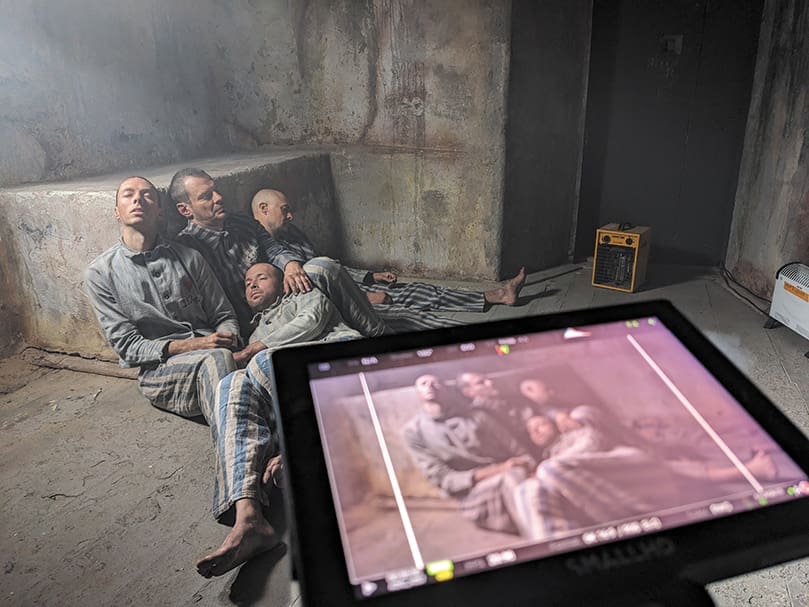
 Photo by Patrick Blonski
 Atlanta
Catholic filmmaker experiences ‘Triumph of the Heart’
By SYLVIA DORHAM Special to the Bulletin | Published August 26, 2025 | En Español
ATLANTA—Patrick Blonski, 34, of Atlanta, knows a thing or two about the film-making industry.
A graduate of Penn State University Film School and son of Polish immigrants, the Catholic videographer made his way to Georgia in 2019.
“A colleague in Philadelphia told me Atlanta was an up-and-coming film location, and it was less expensive than New York or LA, so I came,” he said.
Working freelance in the area for several years, Blonski encountered Catholic Creatives, a Dallas-based networking group of Catholic artists co-founded by filmmaker Anthony D’Ambrosio. There, he heard of a project featuring the final days of St. Maximilian Kolbe, a Polish Franciscan priest martyred in a starvation bunker at the German concentration camp, Auschwitz, in 1941.
In 2023, D’Ambrosio texted Blonski, inviting him to be a part of the volunteer film crew for the movie, “Triumph of the Heart.”
“Anthony decided the only way to do justice to the film was to shoot in Poland,” said Blonski, who went on to describe the culture of Poland as a place where “people love the story of St. Maximilian Kolbe. He’s embedded in people’s hearts.”
Poland, explained Blonski, is a land where faith-based movies are common. D’Ambrosio was able to connect with a Polish video production company, an executive producer and actors in Poland. It was clear the Holy Spirit was leading him to film the movie there.
“When Anthony reached out to me, I was in a tough spot, financially. The freelance market had dried up and I was trying to figure out how I would pay all my bills and afford a flight to Poland. My guardian angel said, ‘just say yes,’ so I texted Anthony back and said I’d do it.”
It was a leap of faith.
“To work on a job, rooted in faith in the land of my roots filled me with joy,” he said. As it turned out, God provided a ticket to Poland through an airline employee.
Blonski was not the only one who took a leap of faith to make the movie. Many of the production assistants paid for their own flights and worked for two months with no compensation whatsoever, he said.
A unique set
When Blonski arrived in Poland, he found the volunteer film crew had a special grace of its own.
“Everyone was doing all sorts of different jobs, which is highly unusual in the film industry. It was like a family or parish community. We had our jobs, but we would help each other or be asked to do something unrelated. It was a group of unlikely people who got together and gelled into a great, highly flexible team,” he said.
The crew benefitted from the kindness and help of the local community, an important ally, because there were obstacles from the start. Blonski, whose Polish language skills are fluent but limited, had to drive cars, film scenes, hire local production assistants and translate.
“There was one day when I had to find three trained German Shepherd dogs for an Auschwitz scene—tomorrow!” Blonski laughed at the memory and recalled another.
“There’s a scene where the prisoners eat a rat. It’s a gross but beautiful moment because St. Maximilian stops their animalistic behavior and prays the before-meal prayer before they share it,” he recalled.
“We all looked at the art director, wondering what she was going to pull together in an hour for an edible rat. She came up with prosciutto and wrapped it around a hot dog. She got some kind of fur-like handkerchief and an old soggy carrot for a tail. When they bit into the prosciutto, it was stretchy and looked a lot like an animal.”
“There was a feeling that we were safe, and that God was holding up this project,” he said. “Everything always worked out and not just worked out. We rolled the cameras with that rat, and it looked fantastic. That was the nature of the project.”
Spiritual pilgrimage
The filming provided space for God’s grace to work in the lives of actors and crew members.
“The film was like working on a pilgrimage,” said Blonski. “We were together for two months. We got to know each other and grow together. Some were new to film, some new to Christianity. It was a microcosm of the larger society.”
“Before we shot in the morning, the whole crew would say a short prayer and have a moment of reflection led by Anthony. We were not all Catholic, but it was important that we remembered we were filming about real people. In that way, Anthony treated the set like it was holy.”
Christopher Sherwood, the actor who played the antagonist, described what he saw through the eyes of his character, a German commandant: “I almost feel jealous of the actors playing prisoners because they had a brotherhood. I put them in the starvation bunker to have them eat each other but St. Maximilian Kolbe made them into a unity.”
Blonski remembers feeling jealous of the prisoners, too.
“It was because of the fellowship they had. That is powerful, when you consider our world. Something so simple as being a friend and building community is priceless.”
“On the last day, Anthony did a meditation and thanked everyone. One of the art directors told Anthony that because of this project, he was going back to church. We heard a lot of that. To know that someone wanted to go to church because of the film shows the power of telling these stories,” he said.
“My hopes for the film are that it will have a strong enough grassroots movement to get released in many theaters. Some miracles happen through our participation—that will be the success of this film, if people spread the word and go see it. I hope those with hardened hearts will have a little fleshiness after seeing it.”
Editor’s Note: Dorham’s piece was originally published in the Feb. 6 issue of The Georgia Bulletin.