


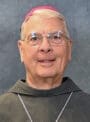
 Archbishop Gregory J. Hartmayer, OFM Conv., is the seventh Archbishop of Atlanta. In “Peace and All Good,” he shares pastoral reflections.
Lent in the Year of St. Francis of Assisi
By ARCHBISHOP GREGORY J. HARTMAYER, OFM Conv. | Published February 24, 2026 | En Español
Each year, the season of Lent comes to us as a gift—40 days in which the Church invites us to return to the Lord with all our hearts. Prayer, fasting and almsgiving are not ends in themselves; they are the concrete ways by which Christ draws us more deeply into his paschal mystery. Lent is always about conversion, but this year it carries a particular grace for our archdiocese and for the whole Church.
Franciscan Jubilee Year
In this Jubilee Year marking the 800th anniversary of the death of St. Francis of Assisi, Pope Leo XIV has designated a Holy Year in honor of St. Francis, inviting the faithful to rediscover the Gospel through the witness of the Poverello, the “little poor man.” It is no coincidence that this Holy Year gains momentum during Lent, the season that most clearly reveals the shape of Francis’ life:conformity to Christ crucified.
St. Francis himself wrote, “Consider well the Good Shepherd who, to save His sheep, endured the suffering of the Cross.”
He did not write these words as a theologian writing about doctrine but as a man who had let the suffering of Christ enter his own body—literally.
Near the end of his earthly pilgrimage, St. Francis withdrew to Mount La Verna to pray and fast. There, contemplating the suffering love of Christ, he received the stigmata, the wounds of the crucified impressed upon his own body. Francis did not seek suffering for its own sake; rather, he desired intimacy with Christ. As he once prayed, “My Lord Jesus Christ, I beg you to grant me two graces before I die: to feel in my heart, as far as possible, that love with which you were inflamed to suffer willingly for us.”
Lent invites us into that same prayer—not dramatic, but real; not abstract, but exemplified.
The Stations of the Cross
The Stations of the Cross are very dear to the Franciscan tradition. To walk with Christ from condemnation to Calvary is to learn the logic of self-giving love. Pope Leo reminds us: “The Cross is not a detour on the road of discipleship; it is the road itself. Those who walk it with Christ discover that even suffering, when united to love, becomes a place of resurrection.”
Lent trains our hearts to walk that road with humility and hope. I invite you, this Lent, to pray the Stations of the Cross with a new awareness of the example St. Francis left us. He did not walk the way of the Cross as a spectator but as a follower—and eventually, as one who shared in its wounds.
Francis wrote: “We should all consider, O brothers, the Good Shepherd who, to save His sheep, endured the suffering of the Cross. For it was His will to save us, and so He humbled Himself and became subject to all.”
At each Station, let us ask ourselves: Am I willing to follow him here? Not merely to observe, but to follow—into humility, into service, into the surrender of everything we cling to.
A prayer for peace
The Holy Father, in his letter opening the Franciscan Jubilee Year, reminded us that we live in an era marked by what he called “apparently endless wars” and deep social fractures. He pointed us back to Francis and the traditional Franciscan greeting—“The Lord give you peace”—as the heart of an evangelical witness that this broken world desperately needs. The pope has asked that we become, through Francis’ intercession, “unarmed and disarming witnesses of the peace that comes from Christ.”
This peace is not the peace the world gives—not the absence of conflict achieved through power or compromise. It is the peace that passes all understanding, the peace won on the Cross and poured out through the wounds of Christ. Francis understood this with a clarity few have ever matched. He wrote in his Admonitions: “Let all the brothers love one another as the Lord gave us an example. Let each one love his brother as much for the soul as for the body.”
Plenary indulgence
As part of this Holy Year, Pope Leo has also granted the opportunity to receive a plenary indulgence under the usual conditions. A plenary indulgence is a full remission of temporal punishment—a complete cleansing, leaving nothing to be purified. It may also be offered for a soul in purgatory, a profound act of mercy toward our departed brothers and sisters.

In the Archdiocese of Atlanta, St. Philip Benizi Church, Jonesboro, is one of several churches designated as pilgrimage sites for the Year of St. Francis of Assisi. Photo by Nichole Golden
An indulgence is a beautiful expression of the Church’s maternal care. While the sacrament of reconciliation forgives sin, an indulgence remits the temporal effects that remain, healing wounds sin leaves behind. It is not a “shortcut to heaven” but an application of Christ’s mercy from the Church’s spiritual treasury.
A decree of the Apostolic Penitentiary establishes guidelines for obtaining this plenary indulgence during the Year of St. Francis. From the Feast of the Presentation of the Lord, Feb. 2, to the Solemnity of the Baptism of the Lord, Jan. 10, 2027, the faithful may receive it by passing through the Pilgrim Door at each church and fulfilling the required conditions.
In the Archdiocese of Atlanta, I have designated these churches to be pilgrimage sites: Holy Cross Church, Atlanta; St. Philip Benizi Church, Jonesboro; St. Francis of Assisi Church in Cartersville; St.Francis of Assisi Church in Blairsville; St. Anthony of Padua in Atlanta; and the Catholic Center at the University of Georgia in Athens.
The Church requires certain conditions to receive a plenary indulgence. Each one is itself an invitation to deeper conversion:
First, sacramental confession. We must have confessed our sins with genuine contrition and a firm resolve to amend our lives. Without the forgiveness of guilt, there is no temporal punishment to remit.
Second, the reception of holy Communion. We are called to unite ourselves to Christ in the Eucharist—to let his body and blood nourish and heal the wounds sin has left upon our souls.
Third, prayer for the intentions of the Holy Father. An Our Father and a Hail Mary offered for the pope’s intentions are suggested—a small act of communion with the universal Church and its shepherd.
Fourth, a sincere interior detachment from all sin—even venial sin. This is the most demanding condition, and the most revealing. It does not require perfection. It requires honesty—a genuine turning of the heart away from the desire to sin. If this full detachment is not yet achieved, one still receives a partial indulgence.
Fifth, the prescribed work itself: a pilgrimage to any Franciscan conventual church or place of worship dedicated to St. Francis anywhere in the world.
These conditions need not all occur on the same day. The confession, Communion and prayer may be fulfilled within approximately 20 days before or after the pilgrimage.
For the elderly, the ill, or those who cannot travel for serious reasons, the indulgence may be obtained by spiritually uniting oneself with the jubilee celebrations. These conditions remind us that indulgences are not mechanical acts, but moments of grace rooted in conversion, communion and prayer.
A Lenten invitation
St. Francis would never want the focus to rest on himself. His whole life pointed beyond him to Christ. As he famously exhorted his brothers, “We adore you, O Christ, and we bless you, because by your holy Cross you have redeemed the world.”
Lent, the Cross, the stigmata, the Stations—each teaches us the same truth: salvation comes through love poured out.
Pope Leo wrote that “In St. Francis, the Church sees what happens when the Gospel is taken seriously without conditions or compromises.”
May this Lent, and this Franciscan Holy Year, help us do just that. May we return to the Lord with simplicity of heart, embrace the Cross with trust and allow Christ to conform our lives ever more closely to his own.
As we journey toward Easter, may we discover anew that the path of repentance is also the path of joy—and that, with St. Francis, we can say with confidence: “From now on, I will say little, for I have learned enough: God is enough.”