


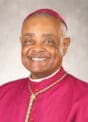
 Archbishop Wilton D. Gregory was the sixth archbishop of the Archdiocese of Atlanta. During his years of service, he wrote a regular column for The Georgia Bulletin entitled, "What I have Seen and Heard".
What I Have Seen and Heard (April 26, 2007)
Published April 26, 2007
I am honored because such a request first of all acknowledges that folks believe my prayers will in some way be efficacious and that they recognize the union that binds me to them as their Shepherd. Our people have an entitlement upon my prayers for them and for their loved ones.
We priests take a solemn promise to pray for our people. Pastors, including the Archbishop, are required to offer Mass for our people on a regular basis. These Masses are part of our pastoral responsibility to the people entrusted to our care—you can tell these Masses when they are scheduled in parish bulletins because they are listed: Pro Populo—for the people. But above and beyond that specific canonical obligation, we must include our people in our daily prayer life. Every pastor should envision the many faces of our people when we kneel before the Lord in prayer.
This past week, I remembered the victims of the Virginia Tech tragedy, as did all of you, I am sure. Those fine young men and women, faculty and staff who lost their lives in a senseless act of violence were very much in the minds and hearts of people all over this nation and indeed throughout the world. There were untold numbers of memorial services for them and those whose lives have been so permanently altered by this tragedy. But above and beyond the many public ritual activities that took place, people privately remembered those whose lives were lost, those who were injured, and all of the family members of the victims in our prayers. We prayed for the healing of all victims of such violence. Our very act of praying for them strengthened our unity as a nation and specifically underscored the religious heritage of our society.
In our highly secularized world that so often scoffs at religious behavior, customs and practices, such moments of deep sorrow and suffering even find a level of tolerance and endorsement in venues that usually provide little space for such beliefs. I was encouraged by the media attention to the benefit of spiritual comfort that religion provides for people in moments such as we lived through this past week.
There was a similar openness to faith in the wake of 9/11. As you may recall, during that first weekend after those attacks, church attendance surged everywhere. There was an obvious public need not simply to think of faith as a private, personal concern, but to gather together in worship in the wake of such an awful event. When faced with great turmoil and tragedy, even our ordinarily skeptical society admits that religion continues to play an important role in society. It would be nice to find a similar openness in less catastrophic moments.
Every priest knows that tragedy and intense joy often increase a person’s openness and willingness to seek God’s presence and the Church’s ministry. Those are key moments in the pastoral care of our people—sickness, death, marriage, birth or a loss of any type bring individuals an awareness that life is more than what we can possibly control or grasp with our own eyes. Even the influence of our trendy New Age viewpoints, which emphasize an individual, highly privatized spirituality in such instances, takes a backseat to the communal experience of a shared faith and religious behavior that draws folks together to call upon a God who is infinitely more than I can capture in the limits of my own personal thoughts and visions.
Our Catholic faith has a unique and wonderful expression of that familial religious value. We believe in the Communion of the Saints, that bond that unites us across ages, cultures and space. We are not mere individuals journeying through life alone, but a family that is made one by the Grace of the Holy Spirit.
Gladly do I pray for those who seek my prayers—and even those who may not have a chance to ask for them personally. I also rely on your prayers for me—because I too need them as a member of this family of believers.