


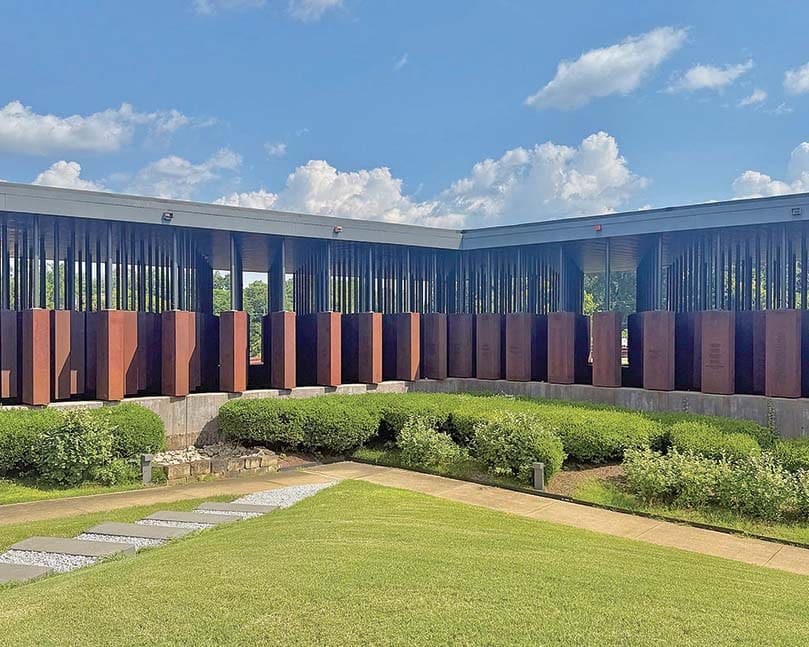
 PHOTO BY NATALIA DURON
Atlanta
More than a headline: Reflections from a pilgrimage to Montgomery
By NATALIA DURON | Published August 6, 2026
The National Memorial for Peace and Justice in Montgomery, Alabama, displays more than 800 steel monuments representing counties across the United States where documented racial lynchings occurred. Among them are 103 monuments representing counties in Georgia.
I stood in front of the Cobb County monument for nearly 10 minutes.
Cobb County is where I drive to church on Sunday mornings. It is where I stop for coffee before work. It is where my family and I go to an Atlanta Braves baseball game.
Standing in front of that memorial, I found myself asking questions I had never considered before. What roads do I travel that once carried people living in fear? What buildings have I stepped in that stood witness to hatred? What stories remain buried beneath my daily routine?
These questions echoed in my head throughout the Archdiocese of Atlanta’s pilgrimage to Montgomery July 1-2.
Led by Ashley Morris, the director of Black Catholic Affairs in the archdiocese’s Office of Intercultural Ministries, the two-day experience was a historical immersion into the city that shaped both the legacy of slavery and the Civil Rights Movement.
We visited the Legacy Museum, the National Memorial for Peace and Justice, the Harris House and the Freedom Rides Museum.
I arrived in Montgomery with 15 other attendees as a journalist, someone who spends my days asking questions and telling stories. But I left with a deeper understanding of how many stories remain unheard, and how much responsibility comes with bringing those stories into the light.
In the Legacy Museum, one exhibit displayed newspaper headlines documenting lynchings throughout the country. I found those displays particularly painful as a news reporter. A headline is powerful, tells the readers what matters and frames an event before the rest of the story is told.
Yet those headlines reported horrific acts of violence with a disturbing sense of normalcy, using language that reflected a society desensitized to the suffering of its own neighbors.
But eventually, I found myself asking, how is that different from the way we encounter tragedy today?
Each day, headlines appear on our phones announcing violence, loss and injustice. We read about young lives taken by racism, mass shootings and acts of hatred, and too often those stories disappear with the next news cycle. Names become statistics as we scroll, grieve and then move to the next story.
The exhibit, and the pilgrimage, challenged me to consider what happens when we allow suffering to become ordinary.
As Catholics, we believe every person is created in the image and likeness of God. That belief demands more from us than simply acknowledging tragedy after it happens. It calls us to resist indifference, to mourn with those who suffer and to recognize that no person’s pain should ever become just another headline.
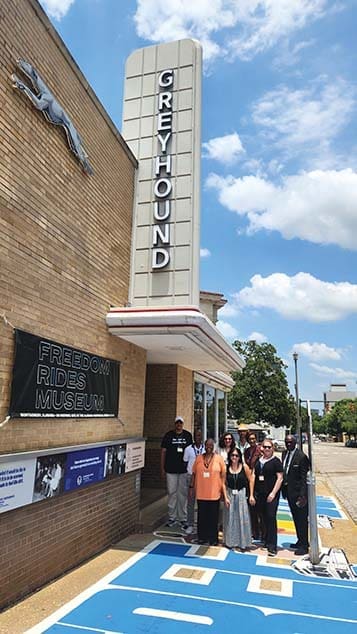
Members of the Archdiocese of Atlanta visited the Freedom Rides Museum during a two-day pilgrimage in Montgomery, Alabama. The museum once stood as Montgomery’s Greyhound bus station. Photo courtesy of Ashley Morris
Standing among those sites in Montgomery, I was reminded that the responsibility of journalism, and the responsibility of my faith, is ultimately the same: to preserve human dignity and to never allow another person’s suffering to become invisible.
The Equal Rights Initiative, a nonprofit organization focused on education, reform and justice, challenges visitors to confront uncomfortable realities, not to assign guilt, but to cultivate necessary conversations.
Because of this, my greatest revelation of the pilgrimage was not what I learned, but what I had never been taught.
Like many Americans, I learned about slavery. I learned about the Civil Rights Movement. But I never knew in 1884, a Black man in Calhoun County was attacked and his home was burnt down with his family inside because he had voted. Or in 1918, a pregnant woman in Brooks-Lowndes County was lynched because she complained about the lynching of her husband.
Anna Fontaine, content specialist for the Archdiocese of Atlanta’s office of Mission Advancement and parishioner of Holy Family Church in Marietta, shared a similar experience. She found herself reflecting on what had been left out of her education during the pilgrimage.
“In having a fuller understanding of the darkness these very real people faced, the power of their courage to work for a better world, at the risk of their own lives, was deeply moving and is something that will always remain with me,” she shared.
Fontaine said the pilgrimage transformed the way she thinks about her vocation, sharing that her job focuses on the experiences of others more than providing her own thoughts.
“The experience emphasized the importance of hearing people in their own words and in their own voice, especially for me as a writer and video creator,” she said. “The pilgrimage underlined the power of direct quotes from people living these experiences.”
For Fontaine, the pilgrimage was “a time of sobering discovery and reflection,” and described the experience as an opportunity to develop a deeper appreciation for the courage of Black Americans throughout history.
“It is essential that we face the brutal and painful parts of our nation’s history,” she shared. “Not only because these violent sins should never again occur, but in understanding the dark aspects of our history, we can better understand the experiences and needs of people in our community today.
Throughout the two days, our conversations returned repeatedly to the Catholic call to recognize the dignity of every human person.
We reflected on the Church’s role in acknowledging painful parts of history, including Pope Leo XIV’s recent acknowledgment of the Catholic Church’s participation in slavery in his latest encyclical, “Magnifica Humanitas.”
The Catholic faith is built on compassion, charity and reconciliation. But reconciliation requires honesty. Acknowledging where we have failed is not a rejection of faith, it is part of living it. And once we acknowledge where we went wrong, we can begin to do right.
Breon Haskett, a parishioner of Transfiguration Church in Marietta and a ministry leader who has spent years serving vulnerable communities, brought that perspective to the pilgrimage through his decades of service.
Through his work with young people, parish ministries, mission trips, outreach with Covenant House and efforts to serve people experiencing homelessness, he has spent years recognizing the suffering of others.
“Much of my ministry has been spent walking alongside people who are often overlooked,” he said. “As I walked through the Legacy Sites, I couldn’t help but recognize a common thread that connects all vulnerable populations: every person longs to be seen, valued and treated with dignity.”
Haskett described his pilgrimage experience “emotionally difficult and spiritually enriching.”
“There were moments of sadness as I reflected on the suffering endured by so many men, women and children whose dignity was denied simply because of the color of their skin,” he said. “At the same time, I was inspired by the courage of those who chose hope over hatred and nonviolence over revenge.”
The pilgrimage reinforced a lesson he has learned throughout his years of ministry, that “our first responsibility isn’t to solve every problem, it’s to recognize the humanity of the person standing in front of us.”
For Haskett, the experience offered an opportunity to think about how he can continue building communities rooted in justice. His perspective reminded me that the purpose of remembering is to not remain in the past.
“As Catholics, we speak often about remembering Christ’s passion because remembering transforms us,” he said. “I found myself thinking that remembering our nation’s painful history serves a similar purpose. We cannot reconcile what we refuse to acknowledge.”
In my two days in Montgomery, I learned that history is never as distant as we imagine. Sometimes it is woven into the places we know best, waiting for someone to ask questions that have gone unanswered for too long.
Haskett said a book teaches facts, and a documentary tells a story. A pilgrimage allows us to encounter history, and in doing so it invites “empathy, conversation and ultimately transformation.”
The pilgrimage left me with a greater responsibility to ask the hard questions, to listen more carefully and to acknowledge what has often been forgotten. More than anything, it reminded me that no person created in the image of God should ever be reduced to just another headline.