


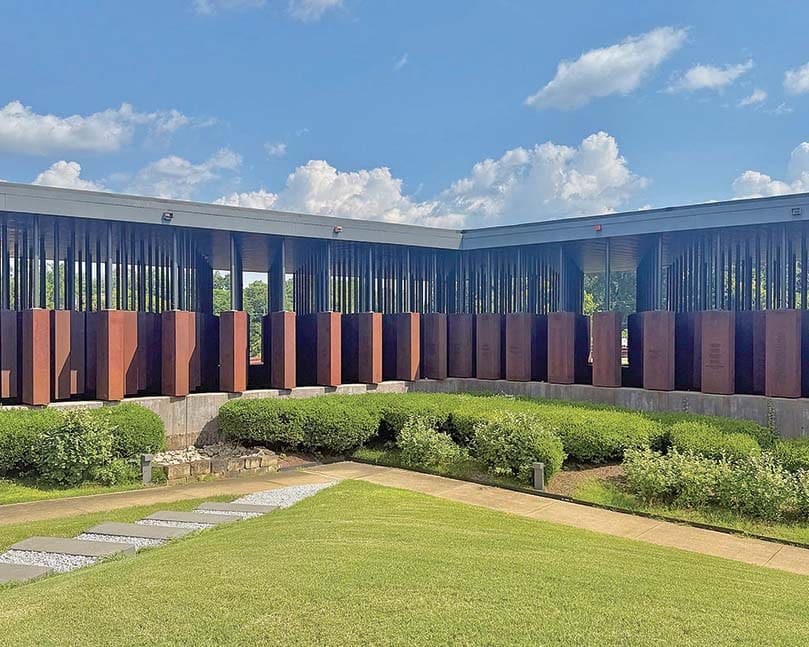
 PHOTO BY NATALIA DURON
Alabama
Archdiocese of Atlanta pilgrimage explores history of racial injustice
By NATALIA DURON, Staff Writer | Published July 14, 2026 | En Español
MONTGOMERY, Ala.—Members of the Archdiocese of Atlanta paused in silence as they stood before monuments bearing the names of counties where lynchings took place. Among them were Cobb, Coweta, Chatham, Decatur and other Georgia counties.
The moment took place at the National Memorial for Peace and Justice during a two-day pilgrimage to Montgomery, Ala., July 1-2.
The pilgrimage is designed to immerse the faithful into the history of slavery and the Civil Rights Movement while inviting reflection on the Catholic call to justice and human dignity.
Led by Ashley Morris, director of Black Catholic Affairs in the archdiocese’s office of Intercultural Ministries, the pilgrimage brought together 15 attendees to visit some of the nation’s most significant civil rights landmarks.
Stops included the Legacy Museum, the National Memorial for Peace and Justice, the Harris House and the Freedom Rides Museum.
“I was inspired by the enthusiasm of all the pilgrims who were honored and willing to journey to Montgomery for the pilgrimage,” said Morris. “This immersion is important for our local Church to help us all intentionally grow in serving, accompanying and ministering with our African American and Black Catholic communities.”
An Alabama city’s place in history
Montgomery holds a significant place in American history. Once a center of the domestic slave trade, the Alabama capital is now known as the birthplace of the Civil Rights Movement through events like the Montgomery Bus Boycott and the Freedom Rides.
The first day of the pilgrimage began with a visit to the Legacy Museum. Built on the site of a former cotton warehouse, the museum is operated by the Equal Justice Initiative, a nonprofit organization focused on criminal justice reform, helping marginalized communities and educating others about race in America.
The museum presents the history of slavery and racial injustice by detailing facts of the transatlantic slave trade, the domestic slave trade, racial terror lynchings, legalized segregation and mass incarceration.
Many of the exhibits are interactive and display artwork. Photographs are not allowed inside the museum, instead visitors are encouraged to pause, read and reflect.
Through facts, photographs, personal statements, artifacts and more, guests follow a chronological journey that presents centuries of racial injustice while highlighting the resilience of those who resisted oppression.
From there, the archdiocesan group visited the National Memorial for Peace and Justice. The memorial honors victims of racial terror lynchings documented across the country between 1877 and 1950.
More than 4,400 names are engraved on some 800 steel monuments that represent a county where lynchings occurred, the Equal Rights Initiative shared on its website. According to a report by the organization, 103 Georgia counties are displayed in the memorial.
As the group walked further into the memorial, facts related to reasons why a lynching occurred could be read inside the memorial walls.
From writing a note to a woman, to standing in a neighborhood, to voting, members of the group prayed in silence for the many lives lost due to racial injustice.

Pilgrims of the Archdiocese of Atlanta and Valda Montgomery Harris, center, stand outside the Harris House. Richard Harris Jr., a local pharmacist, turned his home into a hub for Freedom Riders planning their routes across the country. Photo by Ashley Morris
On the second day of the pilgrimage, the group visited the Harris House, a family home on South Jackson Street that served as a safe and strategic center for students challenging interstate bus segregation.
Home to Richard Harris Jr., the house became a refuge for activists known as the known as the Freedom Riders, including the late congressman John Lewis.
Guided by Valda Montgomery Harris, participants learned how her father, a pharmacist and civil rights supporter, opened his home to white and Black activists challenging the 1960 United States Supreme Court Boynton v. Virginia decision, which banned interstate segregation.
Martin Luther King Jr., the late civil rights activist who led nonviolent protests, visited the home frequently to strategize the bus ride routes.
Through a tour of the home, the group stepped into rooms where conversations were quiet in volume, but loud in impact. Visitors sat in the same kitchen seats and walked on the carpet where students plotted their plan to see if states were complying with the court ruling.
The pilgrimage concluded at the Freedom Rides Museum, which once stood as Montgomery’s Greyhound bus station. On May 20, 1961, rioters and mobs attacked the Freedom Riders who traveled through.

The Freedom Rides Museum, located in Montgomery, Ala., displays newspaper headlines detailing the attacks by mobs on the Freedom Riders. Formally the city’s Greyhound Bus Station, the building now showcases the story of the activists who challenged interstate bus segregation. Photo by Natalia Duron
A map of the activists’ travel routes is displayed on the wall, telling the story of those who rode the buses despite threats to their lives. Newspaper headlines and facts of the period are presented throughout the museum. Notably, the museum displayed a large wall of the mugshots of arrested Freedom Riders.
Throughout the pilgrimage, the group participated in guided discussions and prayers. The conversations connected the travelers as they explored the Catholic Church’s efforts toward racial reconciliation.
By walking through places where history unfolded, Morris shared the pilgrimage offered more than an educational experience.
“I was filled with a renewed hope in the efforts of our local Church to help not only expose ministry leaders to key moments in the African American experience, but to also witness their support in creating more archdiocesan opportunities for others to journey and share in similar experiences as well,” Morris said.
