


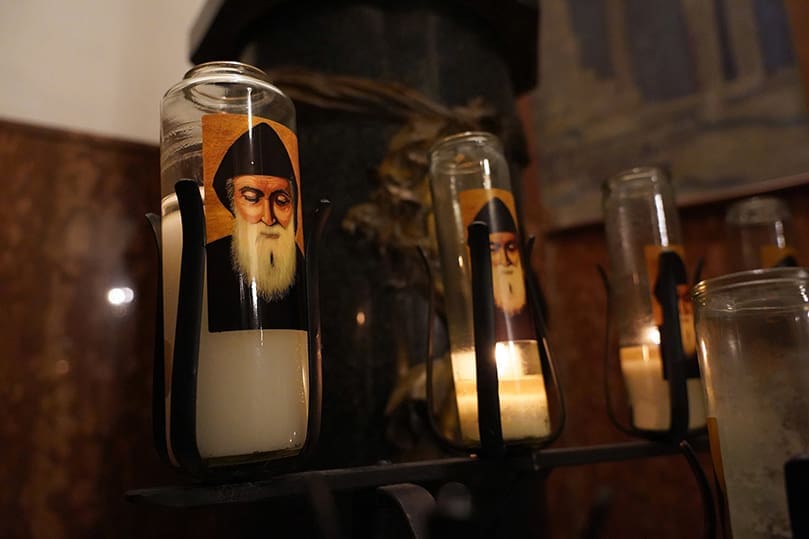
 OSV News photo/Gregory A. Shemitz
Sandy Springs
The miracle monk of Lebanon
By ROBIN CONTE ISAF, Special to the Bulletin | Published July 12, 2025
He is known as “the Miracle Monk of Lebanon,” with more than 33,000 recorded miracles attributed to his intercession. He lived as a hermit for 23 years, renowned for his holiness and asceticism. After his death, his body was incorrupt for 67 years. And yet, he is widely unknown to many Roman Catholics.
This is St. Sharbel Makhlouf, the patron saint of Lebanon.
To the villagers of Bekaa Kafra in the mountains of Lebanon, Yussef Antoun Zaarour Makhlouf was known as “The Saint” since his childhood. Born in 1823, he lived a simple life in devotion to God and obedience to his family until he was 23, when he left home to attend a monastery. There, he joined the Lebanese Maronite Order, adopting the name “Sharbel,” for Charbel of Edessa, a second century Syriac saint and martyr. Sharbel was ordained a Maronite priest in 1859. Yet he desired a life devoted to prayer, and after 23 years as a monk and a priest, requested to move to a hermitage.
Perhaps this precipitated the first miracle associated with him, “the miracle of the lamp.” A lamp that St. Sharbel was using had been filled, in jest, by another monk with water instead of oil, yet it burned and gave light as normal. Upon seeing this, his superior understood it as a sign to grant the request to become a hermit.
St. Sharbel gained a reputation as a wonder worker and a healer of both physical and spiritual maladies, able to cast out demons. His humility was renowned. He kept his eyes downward, lifting them only toward heaven or the tabernacle at church; thus, the images we have of him depict him with downcast eyes.
On Christmas Eve, 1898, he died of complications from a stroke and was buried in a monk’s grave without a coffin, as was the rule. Four months later his grave was opened, permission granted due to a phenomenal light that surrounded it. Miraculously, and despite the grave’s dank conditions, his body was not only intact but also excreting what appeared to be blood and water. His body was subsequently transferred to a coffin and a new tomb, and the cloths covering his body were frequently replaced due to the bloodlike liquid that continued to ooze. His body was exhumed multiple times and confirmed incorrupt through 1965, until it was found to have decomposed when exhumed in 1976.
Thousands of miracles have been attributed to the saint’s intercession. Annaya, Lebanon, the site of his hermitage and of his tomb in St. Maron Monastery, attracts an estimated 4.5 million pilgrims a year, of Christian, Muslim and other faith traditions. The monastery’s abbot and his staff manage requests from around the world for intercession and holy items, and they scrutinize and record accounts of graces and miracles.
One of the most remarkable miracles occurred in 1993 for Nohad El Shami, who suffered partial paralysis. She described that one night, she dreamt of two monks who attended her and operated on her as she slept. She awoke completely cured, and there was a wound on each side of her neck. She said that St. Sharbel spoke to her in a later dream, telling her, “I did the surgery to let people see and return to the faith.” The saint asked her to attend Mass often and visit his hermitage every month on the 22nd, which has since become an overwhelmingly popular pilgrimage date.
St. Sharbel was beatified in 1965 and canonized in 1977 by Pope Paul VI, who said at the beatification, “…a new eminent member of monastic sanctity is enriching, by his example and his intercession, the entire Christian people…”
Pastor Tony Akoury of St. Joseph Maronite Catholic Church in Sandy Springs made a pilgrimage to Annaya and obtained a holy relic of St. Sharbel and his holy oil. The faithful in the Atlanta area now have the extraordinary opportunity to receive a blessing with the relic and anointing with the holy oil following the 11 a.m. Mass on Sunday, July 20. The date is in honor of St. Sharbel’s feast day, July 24.
The Maronite rite of the Catholic Church is in full communion with Rome, and this Divine Liturgy is celebrated in both Arabic and English, with the consecration in Aramaic, the language of Jesus Christ. All are welcome to experience this beautiful liturgy and special blessing.