 Photo by Patricia Cincotta
Cleveland
St. Paul the Apostle’s new reliquarium a sacred space
By ANDREW NELSON, Staff Writer | Published July 25, 2025 | En Español
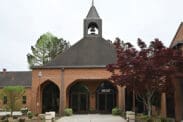
CLEVELAND—Believers seeking a deeper connection to the sacred gather in a newly blessed chapel in St. Paul the Apostle Church, now home to 33 relics of saints and martyrs.
For many years, a parishioner with claims of a family connection to a 17th century pope kept them in a place of honor at a home chapel. But in June, church leaders celebrated the installation of the sacred objects at this parish in Cleveland, about 80 miles northeast of Atlanta.
“They represent what we should all be striving for, which is sanctity and holiness and being with our Lord,” said the donor about the holy men and women. The donor asked to remain anonymous, believing the spotlight should be on the sacred objects. The donor’s family handed down the relics through the generations. According to the family, among its ancestors is Pope Innocent X (born Giovanni Battista Pamphilj).
A family of faith
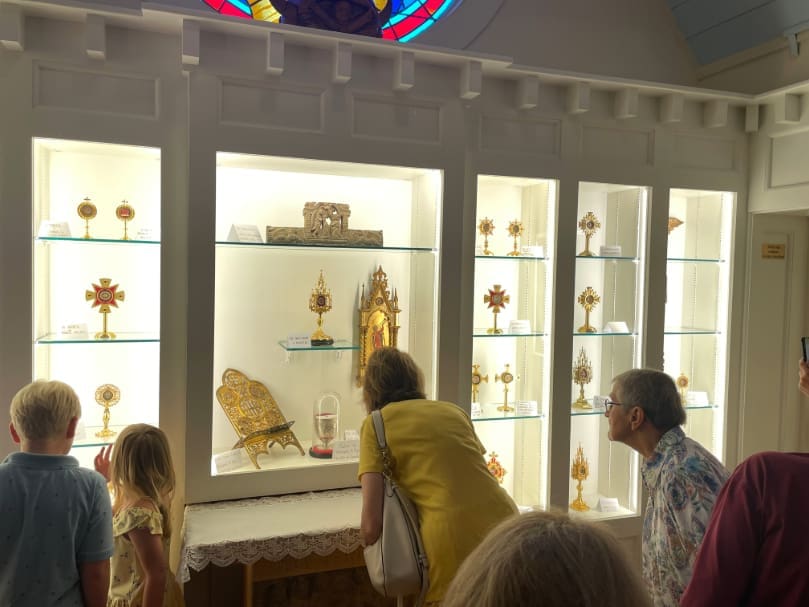
These are first-class relics, remains of martyrs, doctors of the church and saints dating to the earliest days of Christianity. Each is displayed in a gold or silver reliquary for prayer and veneration. Among the display is a splinter from the cross where Christ was crucified.
There are fragments of a saint dragged to his death by a bull. The patron saint of dentists is honored here, remembered for suffering for the faith from a beating that knocked out her teeth. Among them are relics of beloved saints like St. Anthony of Padua and St. Francis of Assisi.
Father Fabio Alvarez Posada, pastor, blessed the special chapel during the installation celebration.
In an email, he said his hope is visitors to the chapel realize how these “common people, now saints,” gave their lives to Jesus. “They are testimonies for each of us with their different personalities. They accepted him and walked with him. We hope our visitors will do the same,” he said.
For himself, Father Posada said he is drawn to the relic of the cross of Jesus. ‘It represents the salvation that was provided to all as Jesus gave his life for each of us.”
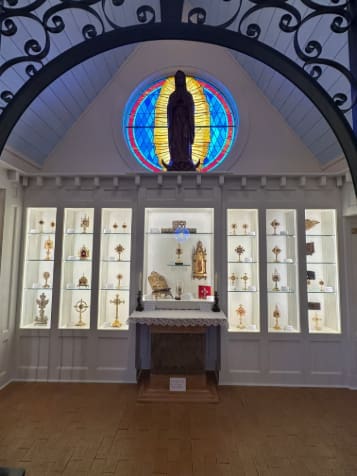
St. Paul the Apostle Church in Cleveland has a new reliquarium featuring 33 relics of saints and martyrs, presented to the church by a donor. It is a sacred space for prayer and is open during Masses and parish office hours. Photo Courtesy of St. Paul of the Apostle Church
Relics: A Catholic tradition
The practice of venerating relics has a long tradition in the church. The word relic comes from the Latin “reliquere,” meaning “remains” or “something left behind.”
The church has categorized three classes of relics: First-class relics consist of the physical remains of saints, like particles of bone or strands of hair. An article of clothing or an object used by a saint would be a second-class relic. If a rosary or piece of cloth is touched to a first- or second-class relic, that item becomes a third-class relic.
Father Gerardo Ceballos Gonzalez, the director of the archdiocesan office of divine worship, inspected the relics’ documentation to ensure the certificates of authenticity and seals were proper before public veneration.
A 2017 document from the Congregation for the Causes of Saints outlined how the church should handle the veneration of relics.
Every relic of a saint in the Catholic Church must have a certificate and a seal by a bishop, who acts as a custodian of the saint’s body. The process ensures the relic was received properly and not purchased. The Cleveland parish only accepted relics that had certificates and seals deemed intact and appropriate, he said.
Chapel for veneration
St. Paul Church redesigned an existing chapel to welcome the relics. The objects sit in three museum-like cabinets behind a gate. Also among the donations to the parish are items belonging to Pope Innocent X: a chalice, a missal stand and a wooden carving depicting the Annunciation.
The parish is one of the pilgrimage churches within the archdiocese for the Jubilee Year. The reliquarium will only be open during parish business office hours, Tuesdays through Fridays, 9 a.m. to 2 p.m. or during Mass.