


Hello, Siri: Is it possible to give up AI for Lent?
By DAVID A. KING, Ph.D. | Published February 25, 2026
It’s crunch time for high school seniors.
It’s the last semester before graduation, and while agonizing over looming college and career choices, students are trying desperately to attain the necessary requirements for the coveted Georgia HOPE Scholarship.
Desperate times call for desperate measures, the old saying goes, so many students are resorting to the Siren call of Chat GPT and other AI implementations that promise to do the work for them.
Both my high school sons complain about their many peers who complete projects with the aid of Artificial Intelligence, despite their teachers’ many attempts to curtail the use of such tools.
I share their indignation. Since the publication of Stephen Marche’s famous Atlantic essay a few years ago entitled “The College Essay is Dead,” I have been dismayed at the number of fully original papers I read each semester.
You’ve heard the arguments against AI in education, and in many ways, they fulfill the prophecy Marche made in 2022. College students have always used whatever subversive measures needed to succeed in school. From crib sheets to fraternity and sorority test banks, students have always tried to cut corners in the pursuit of good grades. Term paper ghost writers, tutorial services, and all-night cram sessions were entrenched in American higher education since the Baby Boomers went to college.
Now, students who for over a generation have been led to believe that a college degree is simply a necessary credential for a job can hardly be blamed for making use of the easy, accessible, and free tools that have indeed nearly killed the college essay.
They’re cheating the system, sure. But in many ways the system has cheated them. I recall a common refrigerator magnet from the early 2000s: “I lied on my resume because they lied when they hired me.” It’s not much different from admission to an elite university that costs a fortune, plummets many students into an endless cycle of debt, and leaves them without any hope of meaningful employment or housing beyond their parents’ basement or their childhood rooms.
Reliance upon imagination, experience
The other night, on a clear and mild evening, I sat on my back porch looking at the starry skies, and I thought of two poems—Walt Whitman’s “When I Heard the Learned Astronomer” and Emily Dickinson’s “I Never Saw a Moor.” Whitman’s short poem reads thus:
“When I heard the learned astronomer,
When the proofs, the figures, were ranged in columns before me,
When I was shown the charts and diagrams, to add, divide, and measure them,
When I sitting heard the astronomer when he lectured with much applause in the lecture room,
How soon unaccountable I became tired and sick,
Till rising and gliding out I wandered off by myself,
In the mystical moist night-air, and from time to time,
Looked up in perfect silence at the stars.”
And Emily Dickinson writes:
“I never saw a moor:
I never saw the sea,
Yet know I how the heather looks
And what a billow be.
I never spoke with God,
Nor visited in heaven.
Yet certain am I of the spot
As if the charts were given.”
These two famous American poems were written by the founding artists of what became Modern American Poetry, arguably the greatest English verse written in the late 19th and early 20th centuries. Both Whitman and Dickinson, especially, worked in solitude. They essentially modernized themselves. They had no model to draw upon, besides the Psalms for Whitman and the New England Psalter for Dickinson. For the most part, they relied upon their imagination. They trusted in the value of personal experience and spiritual gifts of faith, hope and grace.
In the Gospel readings for the day lately, Jesus has spent a lot of time alone. He wanders off to desert places, asks people he’s healed not to speak of him, seeks solitude. Why?
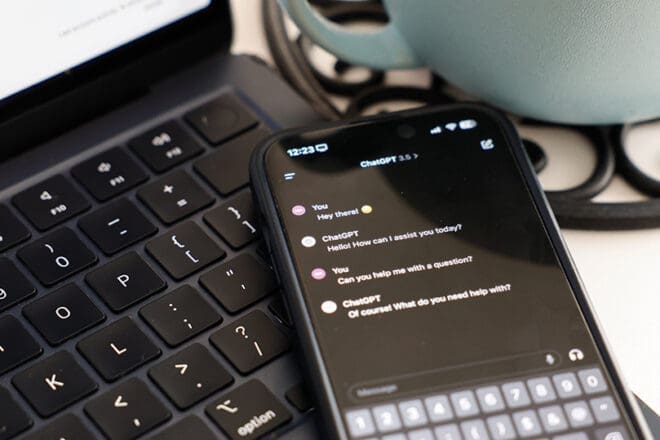
The ChatGPT app is seen on a phone placed atop a keyboard. CNS photo/Lola Gomez
Truly, Jesus spends a lot of time alone. His public ministry begins with 40 days of temptation and suffering in the wilderness, alone in spiritual combat with the devil. After John the Baptist’s murder, “he withdrew from there in a boat to a lonely place apart.” Following the miracle of feeding the 5,000, “Perceiving then that they were about to come and take him by force to make him king, Jesus withdrew again to the hills by himself.” And before his passion and death, he is alone, in agony, at Gethsemane. St. Luke tells us that often, “Jesus withdrew to the wilderness and prayed.”
I’m not a Luddite. I recognize the benefits of AI, and I understand the advantages implicit in its broader implementation. Yet I also recognize its potential danger. AI has already caused the loss of thousands of jobs. It has seriously undermined classical forms of rhetoric and human inquiry such as the argumentative essay. It has been used to deceive and humiliate people both publicly and privately.
By making things easy, AI fools us into accepting the first answer we’re given. It reduces subtlety and nuance. It lessens critical thinking. Above all, it creates an urgency for swift and immediate responses.
Prayer doesn’t work that way. We don’t always get instant answers. Perhaps Jesus goes into solitude so often to teach us that the spiritual life takes patience. As Whitman and Dickinson knew, sometimes we need to be alone with our own thoughts. Sometimes we need to be still and listen. Then the heavens themselves can be made known to us.
Nearly 40 years ago as a brand-new graduate student, I took a wonderful course in bibliography and research methods taught by Dr. Bradley Fletcher at Georgia State University. Dr. Fletcher’s final exam posed several questions, both literary and cultural, and we had to choose five to answer. Our answers had to demonstrate depth and breadth, and we were required to use several different resources, all of them books in the GSU library. The exam took hours to complete. Night after night for over a week, I worked alone in the library stacks and graduate study carrels, not leaving until the library closed at midnight. I learned so much from that exercise, and I still remember what I researched.
For a few years early in my teaching career, I had my students complete the same assignment. They hated it at first, then came to love it as I did. It made them feel connected to the discipline’s past. With the advent of the internet, then Google, it became more difficult to sustain. Now, it is sadly irrelevant.
I recognize that my students have new skills I can hardly fathom. I have no idea how to design a website; I can barely figure out the pharmacy app on my phone. I marvel at the ease with which my students craft sparkling digital presentations. The work they are doing as undergraduates is stunning, and they couldn’t do it without a mastery of the new technology.
Yet I know also that there is no substitute for human conversation, for shared inquiry in a quiet setting, for listening to one another with sincerity and empathy. Likewise, the patience and silence required by contemplative prayer draw us closer to the profundity of God. Even in a perceived absence, there is presence.
This kind of understanding takes time to develop. It requires quiet time in starlight, and solitude in the hills.
I know there is no going back from the technology-based world we’ve created. I know giving it all up, even as a Lenten exercise, is unrealistic. Yet in the speed and clamor of the AI landscape, I hope we have the wisdom not to mistake it for a paradise, and the forethought not to make it a wasteland.
David A. King, Ph.D., is professor of English and film studies at Kennesaw State University and director of OCIA at Holy Spirit Church, Atlanta.