


‘Nature to advantage dressed’: Alexander Pope’s triumph over anti-Catholicism
By DAVID A. King, Ph.D. | Published January 29, 2026
Walker Percy often joked that when asked, as he often was, why he was a Catholic he wished he could simply say “What else is there?” and leave it at that.
Percy knew, of course, that it wasn’t that simple, for in the South especially that question was often implicitly prejudiced and ignorant. Being Catholic in a non-Catholic region or country isn’t always easy.
In 17th and 18th century England, it was difficult and dangerous, for Britain following the 1660 Restoration of Charles Stuart to the throne was staunchly anti-Catholic. Anti-Catholic sentiment existed not only in the streets, but in the work of its marvelous writers, among them Daniel Defoe and Jonathan Swift.
Defoe’s beloved novel Robinson Crusoe features a castaway as both skeptical and scornful of Catholicism, full of piety and high sentence, who initially places his own individuality above communion. Swift might have been the dean of the Protestant St. Patrick’s Cathedral in Dublin, but he was bitterly anti-Catholic. When Swift renounced Catholicism, he wasn’t being satirical, as was his gift; he was serious.
To be fair, Catholics weren’t the only Christians who faced persecution in at this time in England. Puritans and other Protestant sects who refused to ally themselves to the Anglican Church also suffered public scorn and discrimination. The Test Act of 1673 required all civil and military officials to publicly renounce transubstantiation. The conflict between Crown and Court and Catholics reached a climax with the debacle of William of Orange and James II in the late 1680s. Meanwhile, the dying Charles II received the Roman Catholic last rites. That a king had disguised his real faith sadly illustrates the paranoia and political folly of the age.
Catholics in this era of outright bigotry could not hold office. They could not participate fully in public life. They were blamed for all manner of social problems, even the Great Fire of London. And they could not attend university.
That the great English Catholic poet Alexander Pope was able to craft any sort of living from literature in this era is a wonder; that he did so with such original genius is amazing. Among all the great English poets across British literary history, Pope stands with only a few who are pillars of their age. We associate Shakespeare, Chaucer, Wordsworth and Yeats with certain eras; likewise, Pope represents the finest poetry in Restoration Literature.
Yet Pope was almost entirely self-educated, and he became a prototype for the professional writer, one who writes not only for the public good, but for his own sustenance.
Being a true Wit
Pope was born in London in 1688 and suffered serious illness from the start. From boyhood to adolescence he convalesced in rural sick beds, reading all the time. A prodigy, he was writing serious poetry as a child and by age 12 had composed the widely anthologized “Ode on Solitude.” The poem’s lines reveal a boy already resigned to his simple destiny: “Happy the man whose wish and care/A few paternal acres bound,/Content to breathe his native air,/In his own ground.”
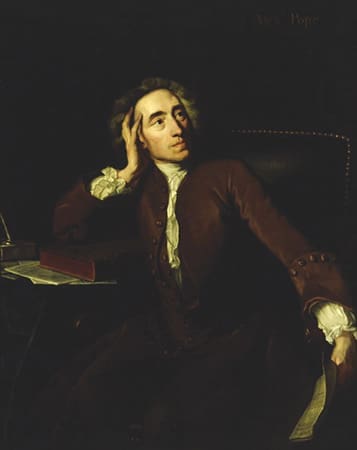
The great English Catholic poet Alexander Pope was almost entirely self educated. Pope became a prototype for the professional writer, one who writes not only for the public good, but for his own sustenance. Jean-Baptiste van Loo, Public domain, Wikimedia Commons
Kept out of university, he made a living through translations, and he continued writing verse. His first major work was the long poem “An Essay on Criticism,” which famously declares “True Wit is nature to advantage dressed,/What oft was thought, but ne’er so well expressed.” Those lines present a simple summation of Pope’s life and work as a man who found a way to unite his talent and passion with his vocation, a man who understood his own unique nature and identity, and who against a cruel conformity became a true original.
Pope reminds me in some ways of the current Catholic trio of late-night television hosts, for he was funny, and served as a sort of public figure, especially in his efforts regarding the imaginary “Martinus Scriblerus.” As much as he was a brilliant poet, Pope never ceased trying to be something broader: a Wit.
For Pope, being a Wit meant something more than just having a sense of humor or being quick with a clever response. Wit meant being true to Nature, both physical and human. The Wit was observant, empathetic and sensitive. He saw aspects of the natural world that others might miss, and he understood what those qualities might also reveal about his own identity and relationships with others.
Being a true Wit meant that Pope and Swift could be close friends despite Swift’s anti-Catholicism. Pope was able to look past Swift’s prejudice, while Swift acknowledged that Pope was one of the only legitimate geniuses in literature at the time.
Pope’s understanding of Wit provided a bridge from the Neo-Classical world of the late 17th and early 18th centuries to the beginnings of Romanticism in Blake’s visionary poetry and Wordsworth’s and Coleridge’s “Lyrical Ballads.” The Romantic poets in both Britain and America held fast to Pope’s earlier thoughts about Nature, and while they composed a poetry very different from Pope’s, they furthered his ideal of looking past the trivial and superficial into what Wordsworth called “the life of things.”
Pope’s poetry is marked by precise craftsmanship; he was a formal master, perhaps because of his familiarity with the liturgical tradition in the Mass and Catholic prayer. Above all, he was the greatest poet of the heroic couplet, a pair of lines written in iambic pentameter—five sets of one unstressed and one stressed syllable—that rhyme almost exactly. To write in this manner for even a few lines is difficult; to sustain it for more than 700 lines is a marvel.
“An Essay on Criticism” was followed by other long works, including the satirical “Rape of the Lock,” which is based upon a true feud between two Catholic families arising from a lock of hair. “Essay on Man” is a great philosophical long poem that is ecumenical in scope and concludes that indeed man is “the glory, jest, and riddle of the world!”
“The Universal Prayer” from 1738 is a shorter work that still functions very well as an actual prayer. The poem expresses gratitude for free will and our capacity for reason and imagination, and it affirms the necessity of humility, obedience, and forgiveness. The poem acts almost like a response to the Our Father and concludes with a universal benediction: “To thee, whose temple is all space,/Whose altar earth, sea, skies!/One chorus let all being raise!/All Nature’s incense rise!”
Readers’ choice
For all the great work that Pope composed, “An Essay on Criticism” remains the favorite of most readers. Even those who may not have read the poem are familiar with some of its frequently recited lines, for much of the poem’s wisdom has entered everyday speech. Consider just a few examples: “Fools rush in where angels fear to tread,” “To err is human, to forgive divine,” “A little learning is a dangerous thing,” and “Some praise at morning what they blame at night.” Pope’s gift for figures of speech makes his work accessible and readable, even today. So much of 18th century English seems cumbersome, wordy and dry, but Pope had a knack for stating simply profound truths. I confess that even I am often guilty of mistaking Shakespeare’s “brevity is the soul of wit” as the work of Pope.
Pope did often echo Shakespeare’s advice to “This above all, to thine own self be true,” both in his writing and in his life. Rather than writing screeds and pamphlets decrying his station in society, he remained true to his nature to craft poetry that is always instructive and entertaining without being didactic or silly. Instead of hating those who scorned him, he prayed for grace to forgive, and he even befriended people who might publicly have seemed his enemies. In a dark time, he exemplified the better aspects of our nature.
Pope died in 1744 and was buried in Twickenham with his parents, as he had requested. He was not memorialized in Poet’s Corner of Westminster Abbey until 1994, when a stained-glass window was made for him. The pane features his own telling words, “Heaven is won by the violence of song,” a wonderful turn of phrase that asserts his faith in both personal fortitude and the power of art to enact meaningful change.
David A. King, Ph.D., is professor of English and film studies at Kennesaw State University and director of OCIA at Holy Spirit Church, Atlanta.