


Henry Ossawa Tanner’s ‘The Flight into Egypt’ evokes the mystery of St. Joseph’s dreams
Published December 26, 2025
St. Matthew’s Gospel, particularly the opening chapters, takes great care to emphasize the connection between the Hebrew Scriptures and the beginning of Jesus’ life.
The Gospel opens with a lengthy account of the genealogy of Jesus—42 generations—that connects him to the great Patriarchs, particularly David in whose city of Bethlehem he is born.
Connections are made between Jesus and Joseph, Jesus and Moses, and indeed Jesus and the entirety of Hebrew history. Most of these parallels are either too complex or intricate to consider here, but the connection to Joseph the Dreamer is easier to understand.
Like his Old Testament counterpart, St. Joseph is the child of a father named Jacob. Like his namesake, St. Joseph is also a dreamer. On four different occasions in the first two chapters of Matthew, he is comforted or counseled in a dream.
The first occurs when “an angel of the Lord appeared to him in a dream” to assure him that he should take Mary as his wife. The second instance occurs when yet again an angel warns Joseph to take Mary and Jesus into Egypt to flee Herod’s wrath. The third dream assures Joseph that it is safe to leave Egypt and return to Israel. The fourth and final dream instructs Joseph to take his family to Nazareth in Galilee.
Following each instance, we only know that Joseph listens and obeys. He clearly places great stock in the validity of dreams, particularly those that involve angelic visions.
Can you imagine such vivid dreams? I’ve had my share of bizarre dreams after over-indulgence in late night pizza—you probably have as well—but can you recall a dream so compelling that you altered your entire life?
The second dream that warns Joseph to flee into Egypt has always fascinated me the most. Joseph has already seen the infant Jesus visited by mysterious strangers from faraway lands, strangers who worship his son and bestow upon him exotic gifts. Even as the Magi are themselves warned in a dream to avoid Herod, “An angel of the Lord appeared to Joseph in a dream and said, ‘Rise, take the child and his mother, and flee to Egypt, and remain there till I tell you; for Herod is about to search for the child, to destroy him.’ And he rose and took the child and his mother by night, and departed to Egypt, and remained there until the death of Herod. This was to fulfill what the Lord had spoken by the prophet, ‘Out of Egypt have I called my son.’”
The story has always fascinated writers and artists. Not only does it deal with mystery and intrigue, but it also offers great assurance about the comfort God provides in time of trouble. That the journey involves a trip to Egypt is important because of the Old Testament connection. In Hebrew history and Scripture, Egypt is a place from which comes both deliverance in the Exodus and safety from famine in the story of Joseph and his brothers.
Of the many artists who have used the Flight into Egypt as inspiration for their work, perhaps the best is the American painter Henry Ossawa Tanner.
Tanner was born of mixed racial heritage in Pittsburgh in 1859, the son of an African Methodist Episcopal bishop. He studied art under the great painter Thomas Eakins and spent most of his professional life in France. Throughout his career, he was influenced by the Symbolist movement in painting, African American history and the French modern Catholic revival of the early 20th century. Most of all, he was profoundly moved by religious subject matter, and early in his career he devoted himself to art that explored religious themes. As he wrote his family at Christmas in 1896, “I have made up my mind to serve God more faithfully.”
The power of the image
Tanner produced brilliant depictions of many New Testament stories, including the Annunciation and The Visitation, as well as Nicodemus and Jesus. Yet he was particularly enamored with the story of the Flight into Egypt. The story echoed his interest in the Great Migration of African Americans from the South to the urban Midwest and Northeast cities, and it affirmed his faith in providence. Moreover, the evocative nature of the story was suited to his love of symbolism and his ethereal style of painting.
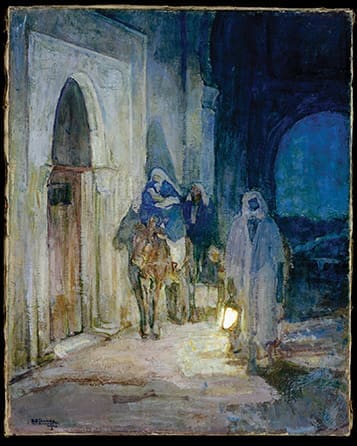
“The Flight into Egypt” is by Henry Ossawa Tanner, an American painter influenced by the Symbolist movement in painting, African American history and the French modern Catholic revival of the early 20th century. Henry Ossawa Tanner, Public domain, via Wikimedia Commons
Tanner painted the subject at least 15 times, including sketches and larger canvases. At least two of the canvases depict the scene in nature, but the most famous of his “Flights” is set in a Bethlehem street or alley. This oil on canvas was painted in 1923 and is in the permanent collection of the Metropolitan Museum of Art in New York City, where it is frequentlyon view.
The painting depends upon three archways—one in the background that evokes both the sea and the belly of Jonah’s whale, which Jesus references later in Matthew’s Gospel; one in the middle ground that perhaps represents either the stable or the crowded Bethlehem inn; and one in the left foreground that may reference Jesus as the new Temple or foreshadow the tomb. The three arches taken together imply the crosses of Calvary. It is important to remember that Tanner identified with the Symbolists, so the viewer should feel free to make symbolic interpretations of the subject.
Likewise, Tanner’s style was meant to be mystical, so suggestion becomes more powerful than literal realism. We don’t see faces, rather forms. The linear gives way to figurativeimpression.
There are four figures in the painting, the Holy Family and a mysterious being who perhaps should be viewed as angelic. The light in the painting is most focused upon Mary and the infant Jesus, both of whom ride upon a donkey. St. Joseph follows shortly behind them, also on a donkey. To the right of the Holy Family, in the foreground, a hooded figure with a lantern—the only apparent source of light in the painting—leads the way from right to left along a diagonal axis of action.
The right-to-left movement and the diagonal line are both important, for each technique is a classic visual cue for tension, suspense, or anxiety. That this unsettling movement is accompanied by light is what gives the painting its powerful appeal and comforting message. One almost thinks aloud, “Even though I walk through the valley of the shadow of death, I fear no evil, for thou art with me.”
The Holy Family are in great danger. They have reason to be afraid, and thus incline toward the shadows. Yet the light offers protection and guidance, and like the light of the infant Jesus it reflects, the darkness cannot overcome it.
“The Flight into Egypt” is one of those special works of modern art that exemplify the power of the image as antidote to the chaotic noise of life. This painting compels silence and wonder, and in its style it echoes perfectly the mysterious quality of dreams.
Of special interest to me is the dreamer himself, St. Joseph. Rather than riding at the front, he occupies the rear of the picture, almost fading into the background. It’s an appropriate placement of this man destined to play one of the most fascinating roles in the Gospel.
At a time when displacement is a very real fear, when immigrants and refugees worldwide are persecuted and forsaken, Tanner’s painting reveals to us the truth of God’s love that compels us ever forward, even when we’re afraid. Like St. Joseph, a dreamer, we need only listen, obey and believe.
David A. King, Ph.D., is professor of English and film studies at Kennesaw State University and director of OCIA at Holy Spirit Church, Atlanta.