


Movies, the pope, ‘The Boss’ and the depth of simplicity
By DR. DAVID A. KING, Ph.D. | Published November 28, 2025
They have a lot in common, Robert Francis Prevost and Bruce Frederick Joseph Springsteen. They’re both Catholic. They’re both working class. They both champion the causes of the poor and the immigrant. And they are both fully American.
You know them by their more familiar titles—“Pope” and “Boss.”
The Pope is of course Pope Leo XIV, the first American successor to St. Peter and the universal pastor of the One, Holy, Catholic and Apostolic Church.
The Bruce of the long-winded name is arguably the most relevant and influential American popular songwriter of the rock music era other than Bob Dylan. He is, quite simply, “The Boss.”
Neither man is afraid to profess what he really thinks, and both speak truth to power. And in case you haven’t noticed, both men are at the top of their respective vocations. Over the past few weeks, each has been a fixture in the Hollywood press.
Springsteen is the subject of the recent maligned and misunderstood musical biopic “Deliver Me from Nowhere,” which is a brilliant portrayal of both a struggling artist and the making of his LP “Nebraska,” one of the most powerful solo records ever made.
Pope Leo has both charmed and puzzled the entertainment world by naming his favorite films, among them “The Sound of Music” and “Ordinary People,” prior to inviting some of Hollywood’s most famous actors and directors to an audience at the Vatican.
If you pause to think about what both the Pope and the Boss seem to really value, it’s very simple.
Pope Leo’s favorite movies are indeed simple stories. “The Sound of Music”—an absolute classic that still plays well today because of its marvelous soundtrack and its universal message of love—is at its core the story of an ordinary woman who finds herself in extraordinary circumstances all because of doubt. “Ordinary People” is a heartbreaking story of simple, and yes—ordinary—people who must deal with terrible sadness.
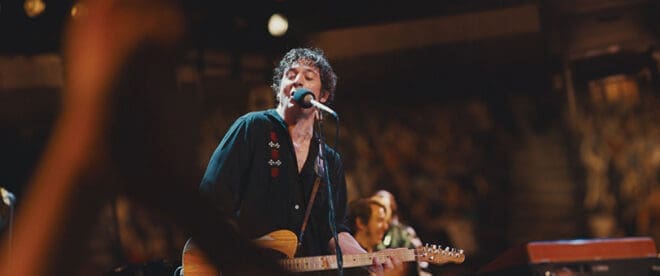
Jeremy Allen White stars as Bruce Springsteen in a scene from the movie “Springsteen: Deliver Me from Nowhere.” The OSV News classification is A-III–adults. The Motion Picture Association rating is PG-13–parents strongly cautioned. Some material may be inappropriate for children under 13. OSV News photo/courtesy 20th Century Studios
Sixty years after its original release, Robert Wise’s adaptation of Rodgers’ and Hammerstein’s Sound of Music remains fresh because its themes of commitment, honor, love, and sacrifice still matter. So, too, does art endure. “The Sound of Music”beautifully affirms the power of art to transform lives.
I recently screened “The Sound of Music” in a film class structured around the topic of the great on-location epic films of the 1950s and 1960s. In contemporary parlance, I thought the film would be received by my students as “cringe.” I was wrong. “The Sound of Music” proved to be one of the most beloved films we studied in the course, among some great movies such as “Lawrence of Arabia,” “The Magnificent Seven” and “The Great Escape.” Unlike those other masterful films, “The Sound of Music” is a simple story. It’s based in truth, like many of the other films we considered, but it is plain. In its innocence and simplicity, even when the characters face great danger, it resonates.
Such is the case with Springsteen’s Nebraska album, the subject of the recent film that has been so misunderstood. Though the record confronts violence as head on as Flannery O’Connor, whose influence is apparent, it retains an almost primitive, primal simplicity in a popular medium that at the time was raging at full speed and volume.
“Nebraska” came after Bruce Springsteen was a full-fledged star. He had been simultaneously on the covers of Newsweek and Time. His albums “Born to Run” and “The River” had been smash hits. Following the tour in support of “The River,” he was expected to decamp and write yet another blockbuster. He did, but he did it in his own way. Much like Maria figures out in “The Sound of Music” that songs are a fine way to settle conflict, Springsteen exorcised many of his own doubts and demons through simple yet powerful lyrics and tunes.
Working alone in his bedroom with assistance from engineer Mike Batlan, and using the newly available TEAC 144 4-Track recorder, Springsteen initially set about to demo songs for the album he thought would become “Born in the USA.” Struggling with the onset of depression and dark childhood memories, Springsteen found himself drawn to the stories of Flannery O’Connor and Terrence Malick’s film “Badlands.” His songs grew darker and more introspective. From the title track about Charles Starkweather’s 1958 killing rampage, Springsteen evoked a desolate landscape of lonely highways, used car lots and decaying boardwalks. Through his own New Jersey version of O’Connor’s “true country,” Springsteen wrote about people not just on the fringes, but off the edge. Yet as bleak as the record is, it ends unforgettably with the hopeful refrain that “Still at the end of every hard-earned day people find some reason to believe.”
A common resonance
For the definitive account of the making of the album, Warren Zanes’ “Deliver Me from Nowhere” is essential reading. I found the film adaptation of the book to be brilliant, from Jeremy Allen White’s and Jeremy Strong’s pitch perfect renderings of Springsteen and manager Jon Landau to the sense of yearning the cinematography evokes. Watching the film was like a visual echo of the record’s constant strum and reverb. Far from being a traditional music biopic such as “The Buddy Holly Story”or “Coalminer’s Daughter,” the film is about the lonely act of artistic creation. The scenes of Springsteen recording his primitive masterpiece reminded me very much of Flannery O’Connor writing at her typewriter in Ethan and Maya Hawke’s recent film “Wildcat.” In fact, the two movies would make an ideal double bill, for both are trying to reimagine prose text as cinema.
Springsteen titled his first great album “Darkness on the Edge of Town,” and to me the phrase captures the real appeal of “The Sound of Music.” A violent thunderstorm is countered by “raindrops on roses and whiskers on kittens.” A true love almost forsaken is redeemed by the hope that “somewhere in my youth or childhood, I must have done something good.” Nazis at the door are countered with lullabies: “blossom of snow may you bloom and grow, bless my homeland forever” and, simply, “So long, farewell.” In all these instances of foreboding, music literally wards off loss and danger. The film and its songs embrace confidence, self-reliance, and faith.
Christopher Plummer unfairly referred to the movie as “The sound of mucus,” and audiences new to the film who expect a sentimental tear-jerker are often surprised at the film’s honest and authentic depiction of heartache and vocation.
Springsteen carried his Nebraska songs on a cassette tape in his pocket. Though his producer and his band tried to make a commercial sounding record of the songs, Springsteen was adamant that only his home recorded version contained his unique vision. In the end—and the book and film recount the recording magic memorably—”Nebraska” was released exactly as Springsteen had heard it in his head and on his tape. Packaged with haunting photographs and lyrics that read like narrative poetry, the album is among Springsteen’s finest work.
And it’s instantly likable, immediately memorable. While the songs of Rogers and Hammerstein and Bruce Springsteen couldn’t be more different, they have in common a striking resonance even after just one listen. They stick with you. They also have something meaningful to say.
I was delighted to hear about Pope Leo’s overture to Hollywood, and even more pleased to know his affinity for the importance of art. His comments to his audience of filmmakers affirmed the deep connection between art and communion, faith and imagination, and they inspired and provoked a segment of the media that might not usually think about matters of religion.
Learning about Pope Leo’s love for the movies made me wonder about his record collection. I wouldn’t be at all surprised to learn that he likes Bruce Springsteen too.
David A. King, Ph.D., is professor of English and film studies at Kennesaw State University and director of OCIA at Holy Spirit Church, Atlanta.