


‘Carlo Acutis: Roadmap to Reality’ highlights beauty of human connection
By LUKE CHILDS, Special to the Bulletin | Published September 22, 2025
It’s always a breath of fresh air when a religious documentary is released and is also met with generally positive reviews. “Carlo Acutis: Roadmap to Reality” is not one to miss. It’s a valuable hour and a half that is guaranteed to leave behind a lingering reflection within the viewer.
Luke Childs
The film follows students from North Dakota Catholic Schools sent on a pilgrimage to Carlo Acutis’ tomb in Assisi. It mainly centers around the journey and its process, while drawing in different perspectives and recollections of Carlo, his life and actions, shared by his mother, father, friends and religious experts.
The students, faced with the reality that this trip would be a no-phone adventure, were immediately hit with the agonizing truth: two weeks, phoneless. But while the film revisits and retells Carlo’s life, it also strings in personal reflections from the students throughout the trip, highlighting how removing phones opened the door to a deeper religious transformation.
Through a beautiful collection of reenacted scenes from Carlo’s childhood, paired with striking visuals, Carlo’s story is told. Alongside his life, the film also presents another message: the world is changing fast, and technology is largely to blame. As tech continues to develop, the more the human soul becomes hidden.
Continuing on the pilgrimage trip, the apparent contrast is made clear with the angsty phone-lacking teens compared to Carlo’s intentional and balanced use of technology to create an online site to catalog Eucharistic miracles.
The film dives deep into the question of how we use technology and offers a critical and necessary warning, especially now, in a world increasingly defined by disembodied connection. The screen is a veil preventing our vision to the transcendent, a barrier that often keeps us from real reflection. Technology has begun to imitate community, but without the spirit. It’s pulling us apart. Carlo, on the other hand, shows us the alternative: a mindful, limited, and spiritual use of tech.
The film wrestles with the idea of finding God in a world full of distractions. Carlo’s moderation and intention with technology show us a better way.
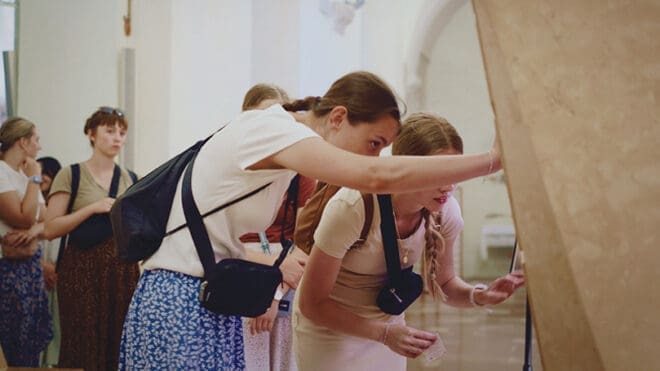
The documentary film, “Carlo Acutis: Roadmap to Reality,” follows a group of teens, traveling without their cell phones, to visit the tomb of Carlo in Assisi. Pope Leo XIV canonized the saint on Sept. 7. Photo Courtesy of Castletown Media
Without phones, the students’ conversations shift. What was once silence or disconnection becomes laughter and dialogue over dinner. These moments, that wouldn’t have been as rich or loud if phones were involved, highlight this growing change in the students’ intentionality and mindfulness on the pilgrimage.
The students begin to understand, through lived experience, what Carlo was trying to teach: connection, reflection and intention.
As the film reaches its pinnacle, when the students come face-to-face with Carlo’s body in Assisi, the reflections have settled: The Eucharist, unlike technology, connects us through the body.
So now we ask: how can we, in today’s world, use technology with moderation while still staying truly connected?
This film is more than just a recognition of a great young saint–it’s a reminder. In a growing world of tech and AI, it’s a call to stay grounded in our innate humanness. Stay connected to life. Be different. Strive for more–not in the eyes of the world, but in the eyes of God. Because as Carlo said: “We are all born as originals, but many die as photocopies.”
Luke Childs is a senior at Marist School in Atlanta.