


A Catholic approach to the death of a pet
By DAVID A. KING, Ph.D. | Published July 12, 2025
Our cat Pancake died two weeks ago. She was a big, beautiful, gentle tabby cat whom we rescued from an animal adoption service on Mother’s Day 14 years ago. When my boys and I presented her to my wife, the cat immediately clung to her, just like the perfect Mother’s Day gift she was intended to be. She was the first pet that all our family selected together, and when she died on June 23 we were all again with her as she took her last breaths.
It hurt. It still hurts hard.
Pancake was not sick for long. When we first took her to the vet, the terrible sores that appeared out of nowhere on her neck were quickly diagnosed as an infection. When the antibiotics the veterinarian prescribed didn’t work after a week, we took her back to the doctor. A biopsy was taken and sent to the Veterinary School in Athens. The result a few days later was what no one wants to hear: malignant and terminal skin cancer of the face and neck.
We gave steroids and pain medication. She didn’t seem to be suffering. As long as she had a little food and water, and lots of attention from us, she seemed to be living fully, if quietly, her proverbial nine lives.
The change came on June 19. We were all set to go to the Braves/Mets game. My wife suggested that we check on Pancake before we left. We found her, bleeding and hiding, in our home office. We didn’t go to the game.
We didn’t do too much of anything until she died a few days later. She chose, consciously I feel sure, not to die until all four of her busy family members could be with her. So one teen, a baby when we got her, came home from the golf course. The older teen, home from work, settled beside her. And in not much time, with all her people consoling her, our sweet animal died.
The English visionary poet William Blake’s line, “We are put on earth a little space that we may learn to bear the beams of love,” captures perfectly the feeling I have for our relationships with our pets. As with anyone we love, taking care of an animal is also a paradox: that which we love deeply can also hurt us deeply.
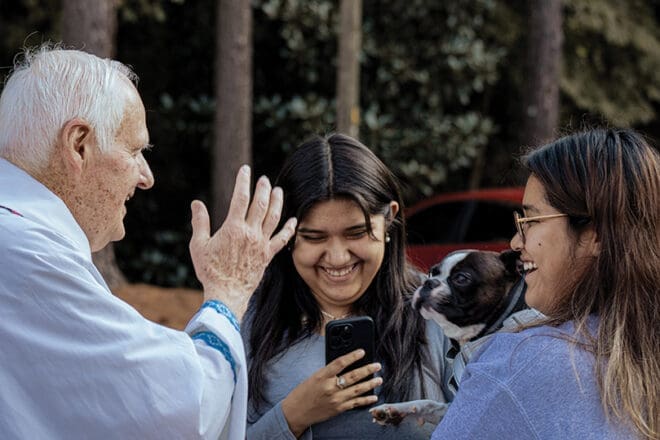
Father John Patrick Sullivan, MS, blesses a family’s beloved dog at the Blessing of the Animals at St. Thomas the Apostle Church in Smyrna in October 2024. Photo by Pablo Ortiz
Because we often mark time by the lives of our pets, one of the hardest things about losing them is how they remind us of time’s quick passage— “When we got her, the boys were just babies.” “When we found him, the kids were just starting kindergarten.” “Remember how we surprised the children with the puppy at Christmas?” “Remember when the kitty slept with us the whole-time granddad was sick?” And before we know it, the children are in high school or college, the grandparents are even older or gone, and life ahead without the animal seems strange and unknown.
I might not be a married man today if not for my rescue of a cat. A few weeks before my wife and I were to be married, she entrusted to me her beloved black cat Hontas to live at our first apartment on 16th Street in Midtown Atlanta. The plan was to let the cat become acclimated to our future home.
For most of her stay in my little apartment, Hontas hid under the bed, until one fateful afternoon when she rocketed out the back door onto my terrace, leaped onto 16th Street, and made a dash for the fence behind the Peachtree Street branch of the Atlanta Public Library. I followed. I followed faster than I ran before or since. I grabbed the back of the cat right before she ascended the barbed wire behind the library, thinking “I may shred my veins, but if I don’t, I may be a bachelor forever.” I saved the cat. We got married. Hontas lived a long and happy life, as did I in those first years of marriage and family.
Remembering God’s creatures
As a Catholic family, we knew that we wanted to give Pancake a proper and fitting burial. We chose a place for her grave in our side yard, in the shade, across from the birdfeeder which she often watched for hours from a secret window.
While the church does not have an official liturgical rite for the burial of a pet, it does encourage us to pray for our animals and remember them as God’s creatures. I found a wonderful liturgical service at a Catholic blog titled “Sentire Cum Ecclesia,” which means “To think with the Church.”
Composed much like official liturgy, the service includes instructions for the preparation of the animal’s body and grave and then follows in four parts. First, Psalm 104, a psalm of praise for every living thing in the cycle of birth, death and rebirth, is recited. Then Revelation 21 is read: “Death will be no more; mourning and crying and pain will be no more, for the first things have passed away. I am making all things new.” A beautiful ecumenical prayer by Rabbi Barry H. Block follows the New Testament reading, along with an Our Father, a Hail Mary and a Glory Be. The service concludes with Cecil Frances Alexander’s hymn that praises “All things bright and beautiful, all creatures great and small, all things wise and wonderful: The Lord God made them all.”
As with official church liturgy, the service gave a dignified and logical sense of purpose to our burial of Pancake. And like all liturgy, it offered comfort.
St. Francis’ famous “Canticle of the Creatures,” composed in 1225 and still recited today, is another good way to mourn a pet, and its refrain of “Praised be you, my Lord, with all your creatures” is a good reminder of how God blesses us through all time with the companionship of animals.
Yet I think my favorite text to commemorate a departed pet is James Dickey’s wonderful poem “The Heaven of Animals.” In the poem, the animals “having no souls” have come anyway, instinctively, to what they perceive to be paradise. In this heaven, much like we imagine, everything is beautiful and perfect, “The richest wood, the deepest field.”
The animals in this heaven do what they did in life, meaning that those who were predators hunt, and those who were hunted are eternal prey. Yet Dickey gives this cycle a twist. The hunters are perfectly designed and equipped, and their hunting is endowed with an ecstasy: “Their descent upon the bright backs of their pray may take years in a sovereign floating of joy.” For those who are hunted, there is no death. “Their reward to walk in full knowledge of what is in glory above them, and to feel no fear, but acceptance, compliance without pain.” Ultimately, the hunted live out a perpetual cycle of rebirth: “They fall, they are torn, they rise, they walk again.”
I do not know if animals have souls, but I am certain that our love for them, and their love for us, offer a glimpse into our own souls’ connection to our God, a creator who knew that it was not good for us to be alone. We needed a helpmate, a companion. We needed someone to love.
David A. King, Ph.D., is professor of English and film studies at Kennesaw State University and director of OCIA at Holy Spirit Church, Atlanta.